Showing posts with label Mohammad Quli. Show all posts

Friday, 9 December 2016

Charminar : grand monument of Hyderabad


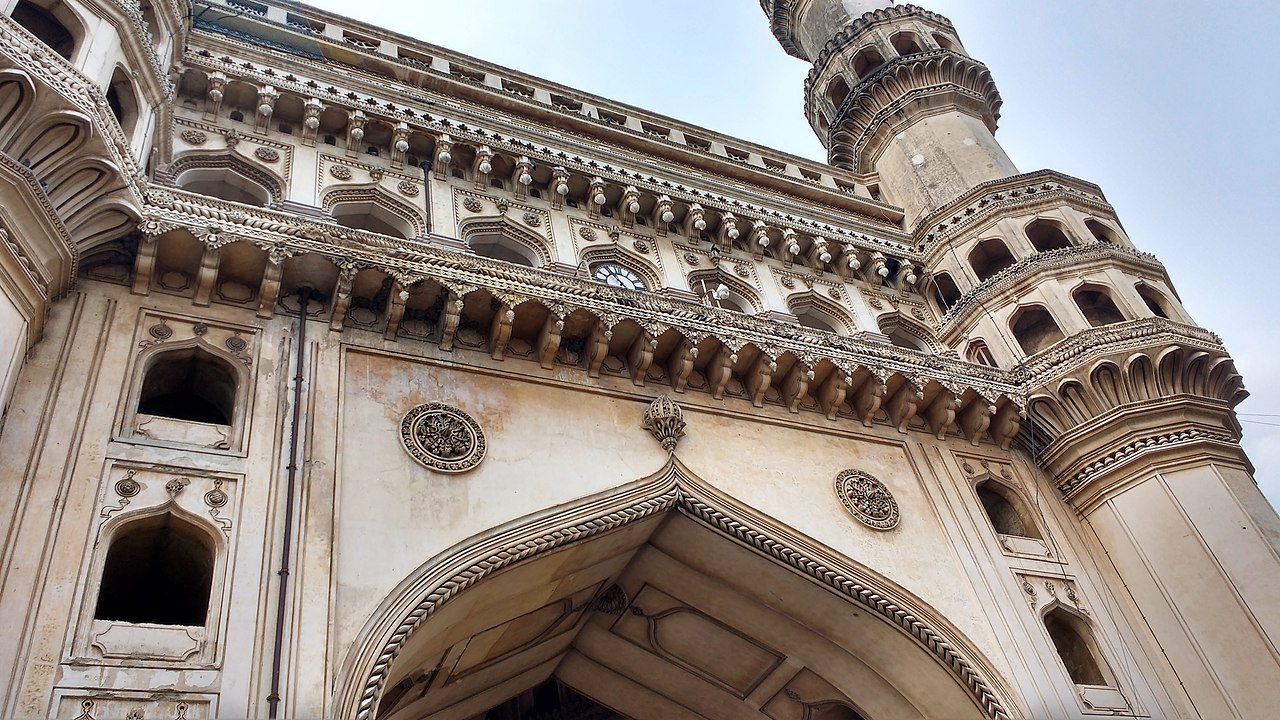
        Charminar is the symbol of Hyderabad; a grand ceremonial monument. It was commissioned by the founder of the city Sultan Mohammad Quli Qutub Shah, the fifth ruler among the Qutub Shahis of the Deccan. The plan of the new city as envisaged by its founder and planned by Mir Momin Astarabadi, his prime minister, had two commercial thoroughfares intersecting at right angles. At the crossing stands the Charminar, a magnificent sight to behold. It is a masterpiece of Qutub Shahi architecture and was completed in 1591. The four huge  arched portals is in the pattern of a quartet each spanning around 11 metres across. At each corner stand the minarets or towers which rise up to 56 metres.They are four-storied. Staircases go up to the balconies and beyond. The Charminar was built to commemorate the eradication of a plague. it is made of granite, limestone, mortar and pulverised marble.

  It is believed that the upper story had a school. Some historians opine that it was used as a pumping reservoir for water from the Jallaplli tank to the palace complex through pipes. It is also believed that the magnificent Charminar only served as a gateway overlooking the piazza into which the royal palaces opened. Guards used to be positioned at the at the Charminar. The western gate served as the gateway of the royal palace.

The western section of the roof of the Charminar has a mosque with 45 prayer spaces with large space in front on whose eastern side are verandahs. A legend says that there is a tunnel connecting Golconda and the Charminar. Another romantic folklore has it that the monument is built at the spot where Mohammad Quli first met Bhagmati who later became his queen.

     In front of the Charminar  is the Charkaman built in 1594 with four arched gateways originally meant to be an open square space, the city piazza. A  fountain-cistern, the Gulzar Hauz originally called Charsoon ka hauz is in the middle of the square. Drummers operated on the eastern gateway, the Naqar Khan-e-shahi, now called as Kali Kaman. The North arch is called the Machchli Kaman(meaning fish arch). The western arch was called Daulatkhana-e-baatil which was decorated with gold tapestry by the prime minister;also a pillar next to it had verses inscribed to protect the royal palaces from evil.

The Charminar is architecturally grand,with its lofty arches and arcaded galleries with foliated balconies. The minarets with circular shafts reach out to the sky. Beautiful stucco decorations are seen inside of the Charminar.

No elephants-led royal processions pass from under the kamans or arches anymore; but on seeing this magnificent monument one can visualise and still hear the echoes of the drums of the royal musicians from centuries ago.
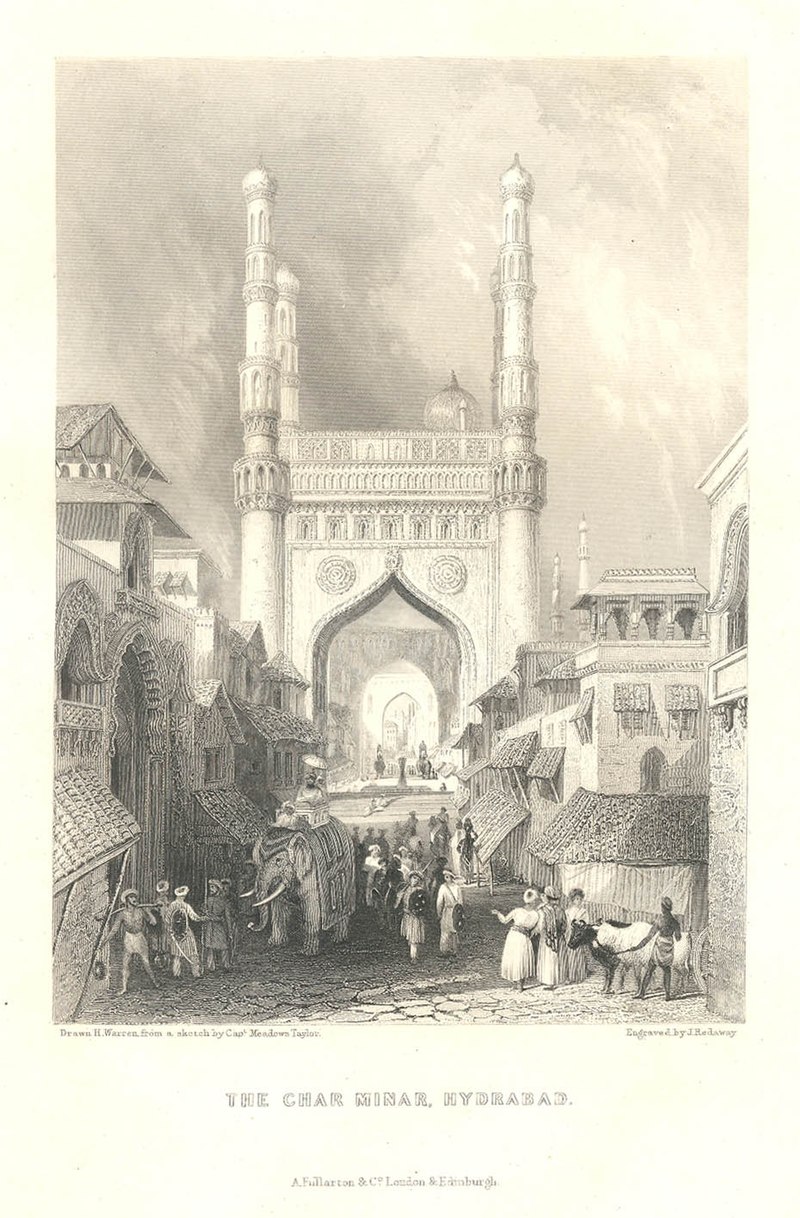
The Char Minar, Hyderabad.jpg


Charminar, 18th century drawing.


By Fullarton's Gazetteer - http://www.columbia.edu/itc/mealac/pritchett/00routesdata/1700_1799/hyderabad/charminarearly/charminarearly.html, Public Domain, https://commons.wikimedia.org/w/index.php?curid=19107417


Arched Corridor on the Top Floor of Charminar (Hyderabad).jpg


Archways on the Charminar.

By Divya Gupta - Own work, CC BY-SA 3.0, https://commons.wikimedia.org/w/index.php?curid=28672819

Image result for charminar images download

Charminar at Hyderabad.


By Gopikrishna Narla (Own work) [CC BY-SA 3.0 (http://creativecommons.org/licenses/by-sa/3.0)], via  


View near Charminar during the month of Ramzan, 2017.

Image courtesy : Saurabh Chatterjee


Charming Charminar 05.jpg


Details on Charminar.


By Aishwarya nemani - Own work, CC BY-SA 4.0, https://commons.wikimedia.org/w/index.php?curid=51823618


File:Sculpture inside Charminar.jpg

Sculptural pattern in stucco inside Charminar

By Shijiltv (Own work) [CC BY-SA 3.0 (http://creativecommons.org/licenses/by-sa/3.0)], via Wikimedia Commons
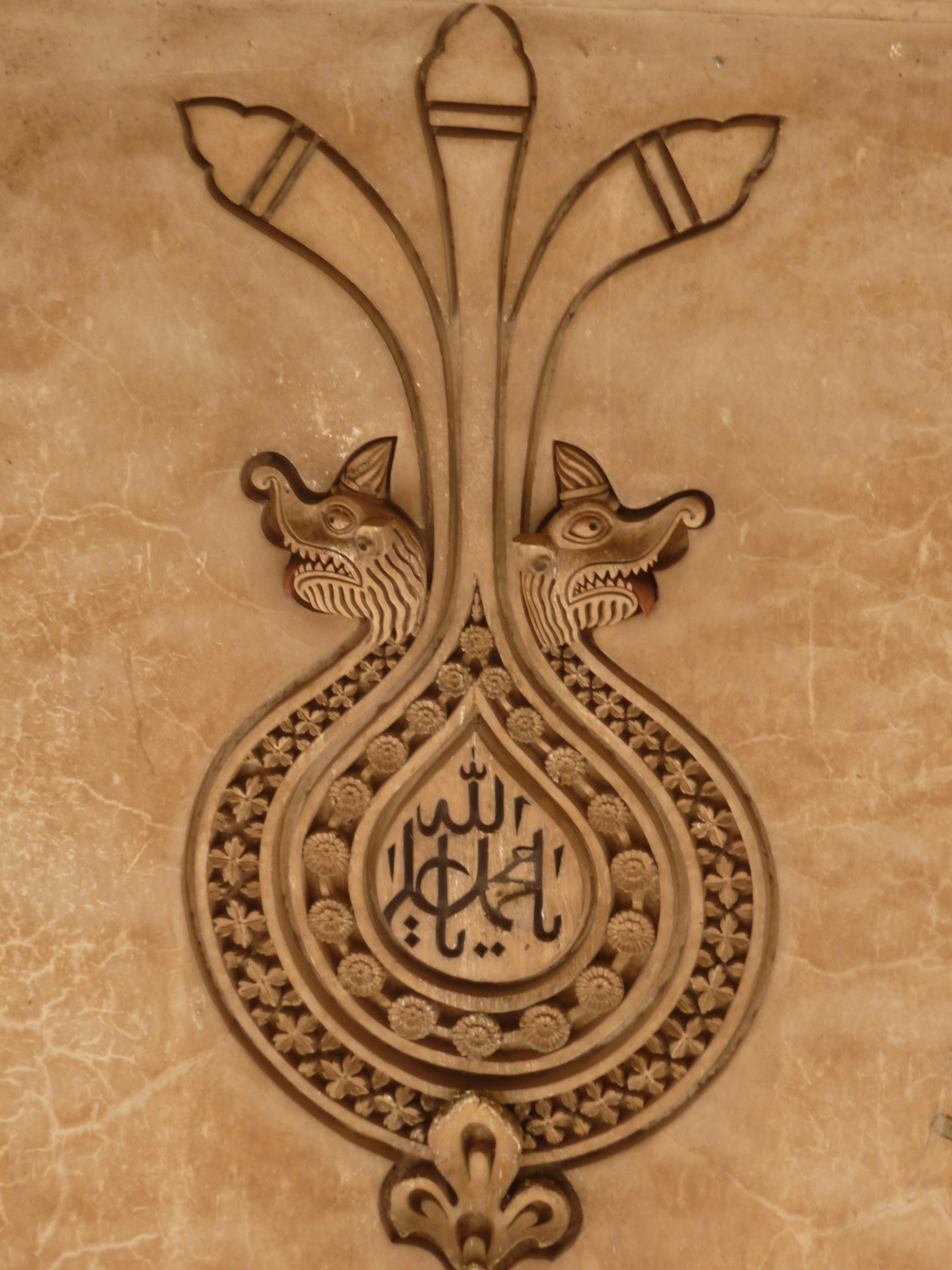
Image result for charminar images

Design of alam (standard) inside the Charminar.

By Jonathan Freundlich (Own work) [CC BY-SA 3.0 (http://creativecommons.org/licenses/by-sa/3.0)], via Wikimedia Commons

Char Minar (Details2).jpg

Floral stucco work on Charminar.

By Navneel neeraj - Own work, CC BY-SA 4.0, https://commons.wikimedia.org/w/index.php?curid=51368363

Decoration on the Charminar.jpg

Decoration inside the Charminar.

By Bernard Gagnon - Own work, CC BY-SA 3.0, https://commons.wikimedia.org/w/index.php?curid=35183015


File:Charminar Stairwell.jpg

Spiral stairway inside the portals at Charminar.

By Vu2sga (Own work) [CC BY-SA 3.0 (http://creativecommons.org/licenses/by-sa/3.0)], via Wikimedia Commons


References :

  • The art and architecture of the Deccan Sultanates/George Michell and Mark Zebrowski,Cambridge : Cambridge University Press,1999.
  • wikipedia.org
  • Hyderabad 400 years/Raza Ali Khan,Hyderabad : Zenith Services,1990.


Posted by :


Soma Ghosh


© author


Friday, 25 November 2016

Bhagmati : the Sultan's beloved


        Did Bhagmati really exist or she is a figment of a romantic imagination ?  Most people would like to believe that she did. Historians will agree and disagree and the debate will continue for ever. However there has been found enough evidence including a tomb in the old city of Hyderabad which is supposedly hers, to indicate her existence during the time of the founder of Hyderabad, Sultan Mohammad Quli  of the Qutub Shahi dynasty of Deccan history of India. She was an important presence after whom not only poetry was composed, but a new city was named, Bhagnagar. It was later changed to Hyderabad after her marriage to the Sultan(after she embraced Islam)and her name was changed to Hyder Mahal.


          It all started on a fateful day  in late 16th century, when a beautiful village belle who was also a dancer, was going to a temple in Chichlam (an area close to the Charminar built later). The sound of horse-hooves startled the young girl who stopped in the middle of her tracks, on way to a temple nearby. The person on the horse looked sharp at her. His friends seem to vanish a little into the background. Who could this be, she wondered. He seemed royal and in the prime of his youth with a very handsome face. He could not take his eyes of her and seemed smitten by her beauty. She went in to the temple and came out after her prayer. He began to converse with her. She too spoke back and a tender friendship  took birth.  More meetings followed and continued for 11 years. 
   
      She became his favourite and once when the river Musi was flooded he came searching for her fearing for her life, crossing it in full fury. Seeing his passion his father the Sultan of Golconda, constructed a bridge, the Purana Pul, as it is known now, so that he would not have to risk his life again to meet his beloved. Mohammad Quli became the king after his father Sultan Ibrahim Qutub Shah died in 1580. This bridge also served to connect the old city with the newer extension of Hyderabad city across the Musi in order to help spread out the over populated fort-city of Golconda.

Image result for purana pul

Purana pul,photograph,Hyderabad,1892.

Lala Deen Dayal [Public domain], via Wikimedia Commons
  

Image result for muhammad quli

Artist representation of the meeting between Bhagmati and Mohammad Quli.

Source : http://www.deccanchronicle.com/nation/current-affairs/110916

    Bhagmati was given special honours by the new king. Every time she came to visit him, 1000 horses would accompany her Though there was strong opposition as Bhagmati was a Hindu woman, Mohammad Quli married her. After converting to Islam she bcame Hyder Mahal. His Peshwa Mir Momin had an important role in the same. 


File:Wedding procession of Muhammad Quli Qutub Shah.jpg

Sultan Mohammad Quli bringing his bride Bhagmati, painting.

https://upload.wikimedia.org/wikipedia/commons/1/1f/Wedding_procession_of_Muhammad_Quli_Qutub_Shah.jpg See page for author [Public domain], via Wikimedia Commons


Bhagmati in a miniature painting, Deccan school.

Source : Nathan Hughes Hamilton on Flickr via Creative Commons from his album 'Samples of Indian Art'.

Bhagmati has been mentioned directly or indirectly in many historical accounts. Ferishta mentions that the Sulltan was fascinated by her. He mentions Bhagnagar whose name was later changed to Hyderabad. Faizi, Emperor Akbar's resident in Ahmadnagar a kingdom in the Deccan, mentions Bhagnagar as being built after Bhagmati. Tavernier (1648 and 1652) Thevenot(1665-66), Bernier(1667) all refer to Bhagnagar in their travel accounts. Bhagnagar is referred to in Tareekh-e-Qutub Shah by Qader Khan Munshi (1888) and Gulzar-e-Asafi (1844).


References :

  • wikipedia.org
  • Luther, Narendra/Prince, poet, lover, builder : the founder of Hyderabad, New Delhi : Publications Division, 1991.
  • Rao, Bhoopala K.V/ The Qutub Shahi Prime Ministers. Hyderabad : Mahamantri Madanna Trust, 1992.

Posted by  :


Soma Ghosh


© author


Mir Momin Astarabadi: architect of Hyderabad


Mir Momin Astarabadi: architect of Hyderabad 


      Going back in time to the 14th century, the Deccan plateau in Southern India was being governed by the Bahmani Sultanate which had been founded in 1347. People from different parts of the world  were coming here and getting settled in the region after securing good appointments at the Bahmani court.

     Mir Momin Astarabadi was one such migrant who was from Astarabad in Persia (Iran). He was from a family of scholars and his family had instilled him with qualities like discipline and civility. He worked as a tutor to the imperial crown prince, Hyder Mirza but  as the prince died unexpectedly followed by his father Tahmasp Safavi; he left Persia and went to Mecca. Finally he came to Golconda in 1580 when Sultan Mohammad Quli was its ruler. 

     Mir Momin was teaching theology and lecturing in mosques and soon became well known in Golconda. He was of the Shia faith and was soon spotted by the Sultan who appointed him as his Peshwa in 1585. 


 Mir Momin Astarabadi (1585- 1624/5 A. D.)

    Peshwa Mir Momin was instrumental in converting Bhagmati, the Hindu queen of Mohammad Quli to Islam and giving her the new name Hyder Mahal. Initially he had tried in vain to wean him away from Bhagmati, the village belle and dancer from Chichlam who was the Sultan's beloved.

      Sultan Mohammad Quli respected his Peshwa who was a spiritual guide to him. Under Mir Momin the Shia faith gained dominance in the Golconda kingdom  and Persian manners and style came to be practised.


     As Sultan Mohammad Quli had no sons he adopted a boy born to his youngest brother Mirza Mohammad Ameen and his wife Khanum Aagha also called Mohammad. He grew up 

learning Persian and Arabic and also learnt fencing, shooting and riding . Mir Momin took it upon himself to bring him up like a prince.  He married Hayat Bakshi Begum, daughter of Mohammad Quli and Bhagmati, with the efforts of Peshwa Mir Momin. On the death of the only claimant to the throne,Khuda Banda, brother of Mohammad Quli he quickly declared the Prince as the next ruler of Golconda. Peshwa Mir Momin thus served two Qutub Shahi Sultans.

  Golconda as capital of the Qutub Shahi kingdom had got too crowded and the Sultan was looking for new space to establish a new city. He found the same to the eastern side of the River Musi (earlier called Muchkunda). The place was lush and very suitable. Peshwa Mir Momin assisted him in his mission. Plans of famous cities like Ispahan were studied and finally the foundation of the Charminar was laid in 1589 and the new city in 1591. The dream city Farkhunda buniyad or Bhagnagar meaning city of fortune was built having palaces, neat roads, gardens,fountains, water supply systems, public health buildings,schools, the royal mint, royal pavillions etc. The Badshahi Ashoorkhana, Jama Masjid, Darulshifa, jilukhana(charkaman)  and palaces like Dad Mahal,Sajan Mahal,Lal Mahl, Chandan Mahal, Khudadad Mahal were made in the new city. Another 14,000 houses were built for traders and people from other professions and given free of cost to them. Thus the city got populated and the capital of the kingdom was shifted to it. 


     Mir Momin was as much a peshwa (prime -minister) and as he was a great scholar. He is supposed to have had mastery over occult sciences too. In fact he got constructed a black granite pillar behind the western arch and got verses inscribed on it, near the Charminar to ward off evil spirits. Behind this there was a big lofty gate with a gold-cloth curtain studded with precious stones. All his books on the occult are buried with him.


    Mir Momin added many books to the royal library. He authored a book Risal-e-maqdariya in Persian which was in 12 parts on weights and measures. He wrote another book Kitab-e-rajiyath besides composing rubayis(quartrains) and qaseedahs (eulogies).

      Mir Momin got made a grave yard in the southern part of Hyderabad, where he lies buried and so does his son Mir Mohammad Majudduddin ; Daira-e- Mir Momin. Sources say that he was  very distressed by the death of his only son and he too passed way on the fortieth day of his son's death in 1624/5 at Hyderabad at the age of 71 years. He had brought camel-loads of soil from Karbala to fill the excavated site. When Mir Momin acquired this land Shah Chirag ,a religious figure from Najaf (in Iraq) had been already buried here. Many other famous people lie buried here which include poet Mirza Muhammad or Naimath Ali Khan, a high ranking official of Mughal Emperor Aurangzeb,the family of the Salar Jungs, Mir Alam, Khan-e-Khanan among others.

Famous Urdu poet from Hyderabad Makhdoom Mohiuddin has said :
Shahar baqi hai, mohabbat ka nasha baqi hai
Tu nahin teri chasme-e-nigaran baqi hai !

References :


  • Khan, Raza Ali/Hyderabad 400 years (1591-1991), Hyderabad : Zenith Publishers,1990.
  • Rao, Bhoopala K.V/ The Qutub Shahi Prime Ministers. Hyderabad : Mahamantri Madanna Trust, 1992.


Posted by  :


Soma Ghosh


© author