
 Posts
Posts


Golconda times : mosques and mystics

Toli Masjid, Hyderabad.
By Aditya369 (Own work) [CC BY-SA 3.0 (http://creativecommons.org/licenses/by-sa/3.0)], via Wikimedia Commons
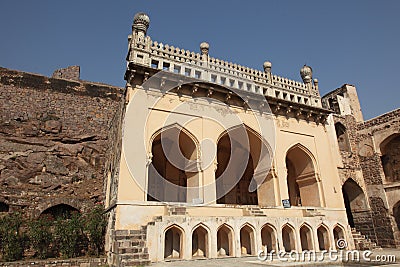
Mullah Khiali mosque, Golconda Fort.
Source : dreamstime.com/stock-photo-ancient-mosque-golconda-fort-hyderabad-image23855290

Hayat Bakshi Begum's mosque, Ibrahimbagh,Hyderabad.
By SharadaAnnamaraju - Own work, CC BY-SA 3.0, https://commons.wikimedia.org/w/index.php?curid=21505978
Heera Masjid is located near the Moti darwaza, built in 1668 under Sultan Abdullah Qutub Shah specially for the diamond merchants. There is a serai within the precincts of the mosque.
Ashrafi Masjid is located on the distance between the Fateh darwaza and Bala Hissar darwaza between the Shamsheer kotha and the Khazan shahi. The mosque has three arches in the facade and Quranic verses on the mihrab. This mosque is dated to 1589.
Chini Masjid is a small masjid near the Khazana Shahi, built around 1589, with a facade of three arches.
The Golconda times saw the building of many mosques, serais, commercial centres and palaces. Some can still be seen today in different states of preservation and glory at various locations in and around Hyderabad.
There are many mosques in addition to the Mecca Masjid and the Jami Masjid near Charminar. Outside and within the fort complex are many mosques.The Jami Masjid or Masjid-e-safa is outside the fort which was built by Sultan Quli, when he was a governor under the Bahmani Sultanate in 1518. The mosque has a single dome and painted arches. The 15 bays of the mosque have stucco decorations at the apex. The spandrels of the arches of the mihrab too has stucco ornamentation.
The Khairatabad mosque was built for Mulla Abdul Malik in 1612, the tutor of Khairatunnisa who was Sultan Muhammad Qutub Shah's daughter. It has a small prayer hall and its facade has three arches. There are two minarets on the sides.
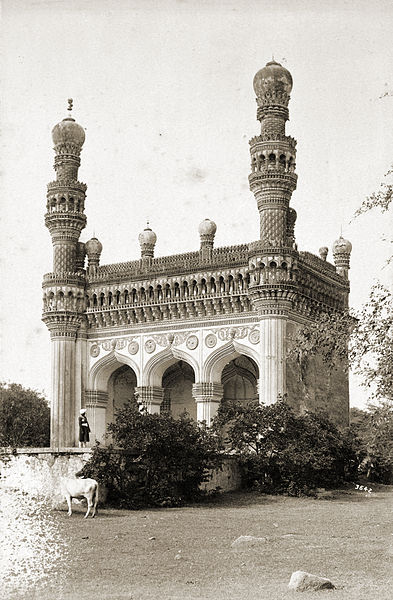
Khairatabad mosque.
By Lala Deen Dayal (1844-1905) [Public domain or Public domain], via Wikimedia Commons
The Khairatabad mosque was built for Mulla Abdul Malik in 1612, the tutor of Khairatunnisa who was Sultan Muhammad Qutub Shah's daughter. It has a small prayer hall and its facade has three arches. There are two minarets on the sides.
Khairatabad mosque.
By Lala Deen Dayal (1844-1905) [Public domain or Public domain], via Wikimedia Commons
Toli Mosque was built by Musa Khan, mahaldar of Sultan Abdullah Qutub Shah in 1674. It is located at Karwan, 2 km from Golconda Fort. The mosque has a double prayer hall and two high minarets and a five arched facade. There are ornate decorations on the facade of the mosque.
Toli Masjid, Hyderabad.
By Aditya369 (Own work) [CC BY-SA 3.0 (http://creativecommons.org/licenses/by-sa/3.0)], via Wikimedia Commons
The mosque below is attributed to poet-laureate Mullah Khiali located between Jallad Burj and Anankob burj. The facade has three arches with stucco motifs. the mihrab has an inscription calligraphed by Syed Sadruddin. The mosque was built during the reign of Sultan Ibrahim Qutub Shah.
Mullah Khiali mosque, Golconda Fort.
Source : dreamstime.com/stock-photo-ancient-mosque-golconda-fort-hyderabad-image23855290
The Hayat Bakshi Begum mosque is at Ibrahimbagh in the Qutub Shahi tomb complex.It was built in 1667 along with her mausoleum. The mosque has a prayer hall with three aisles. The facade has ornate stucco decorations with five arches. The mosque has two tall minarets with a dome at the top set on circular lotus base.
Hayat Bakshi Begum's mosque, Ibrahimbagh,Hyderabad.
By SharadaAnnamaraju - Own work, CC BY-SA 3.0, https://commons.wikimedia.org/w/index.php?curid=21505978
Heera Masjid is located near the Moti darwaza, built in 1668 under Sultan Abdullah Qutub Shah specially for the diamond merchants. There is a serai within the precincts of the mosque.
Ashrafi Masjid is located on the distance between the Fateh darwaza and Bala Hissar darwaza between the Shamsheer kotha and the Khazan shahi. The mosque has three arches in the facade and Quranic verses on the mihrab. This mosque is dated to 1589.
Chini Masjid is a small masjid near the Khazana Shahi, built around 1589, with a facade of three arches.
Baridi Masjid is a mosque close to the Banjara Darwaza built by a Baridi Sultan who took refuge at Golconda. The mosque is plain , the facade has three arches but no minarets. The roof has six shallow domes. the mihrab of the mosque is made of black stone.
Miyan Mishq Masjid is located opposite the Puranapul. Built by Miyan Mishq in 1674, who was a Qutub Shahi commander of the Krnataka troops, secretary, keeper of keys; the facade has three arches and two minarets at the sides.The mosque has large cistern. Some rooms are present at the back of the verandah on the south and the east. There is a hammam behind the mosque. There is a mortuary chamber with a verandah around it. At different places are insriptions in different calligraphic styles on black basalt stone. He has built another mosque at Attapur associated with Miyan Mishk Mahal. The facade of the mosque has three arches with octagonal minarets at the sides. The mahal built by him is a small palace, two storied with arches and a balcony projecting in front.
Shaikpet Masjid, built in 1633/4 by Sultan
Abdullah Qutub Shah is a mosque, a Jama Masjid having high minarets with a facade
of three arches. It is a part of the the serai
complex built for traders, which had 30 rooms and stables for horses and camels.
Inscriptions of Quranic texts are present on the western wall, also some
Persian verses all calligraphed by Hussaini Tabrizi. The mosque has a stone platform.
The traders could pray at the mosque. There is a tomb of a Sufi saint in the premises.
Kulsum Begum's Masjid was built by Princess Kulsum
Begum, daughter of Sultan Mohammad Qutub Shah.The area is called Kulsumpura. It
is
is located on the way to
Puranapul from Golconda. It is fairly large mosque with a facade of three
arches and octagonal minarets at the sides.

Shaikpet masjid and serai, Hyderabad.

Shaikpet masjid and serai, Hyderabad.
Source of image : https://telanganatoday.com/shaikpet-sarai-ravaged-nature(public
domain)
The Qutub Shahi times were highly influenced by the presence of Sufi saints who preached from their khankhas and were approached by people for all sects for guidance and solace. After they passed away, their dargahs are visited by followers. Both Sunni and Shiah sufis were popular. Many sufis visited Golconda The Qutub Shahis were tolerant kings; majority of the Sufi saints were from the Sunni sect. Some of their tombs and dargahs are revered since the Golconda times.

By Govardhan II (http://expositions.bnf.fr/inde/grand/exp_031.htm) [Public domain], via Wikimedia Commons
Hussain Shah Wali was appointed as sipahsalar (commander) and made in charge of public works. He was from the family of Khwaja Banda Nawaz of Gulbarga. He belonged to the chishti order. The Hussain Sagar at Hyderabad is named after him. Hussain Shah Wali's tomb with its attached mosque was built by Sultan Abdullah Qutub Shah. The tomb has a single dome and the entrance to the main tomb is through a wooden gateway. He was married to Khairatunnisa Begum, daughter of Sultan Ibrahim. He passed away in 1620.He is believed to have performed miracles. His dargah is in Toli Chowki.
Syed Hussaini Barhana Shah or Barhana Shah sahib, who came from North India during Sultan Abdullah's reign was a disciple of Sufi Sarmad of Delhi. He died in 1653. His disciple Malik Parast Khan who was a minister of Sultan Mohammad Quli and Sultan Mohammad Qutub Shah, a commander of the royal bodyguard of Sultan Abdullah Qutub Shah, built a rectangular tomb with twelve arches over his grave. A mosque is attached to the tomb and a naqarkhana is present over the gate.
Mir Momin Astarabadi was the chief architect of the city of Hyderabad. He had migrated from Persia and had become peshwa or prime minster at the Golconda kingdom. Sultan Mohammad Quli respected his peshwa who was a spiritual guide to him. He has built a necropolis Daira-e-Mir Momin at Sultanshahi area in Hyderabad.He had acquired the land for burial purposes.He died in 1624/5.His tomb is rectangular structure. The second storey has an ashurkhana where alams (standards) belonging to him are kept. The tomb has four minarets and a flat roof.
Shah Miranji Hussain Chishti was a sufi from Hyderabad who played a major role in enriching the sufi literature in Dakhni Urdu. He died in 1659. His tomb is near the Puranapul.
Shah Raju Qattal was the guide and mentor of Sultan Abul Hasan Tana Shah. He belonged to the Chishti order. Abul Hasan spent 14 years at his khankhah and served him. Shah Raju died in 1681. A three storied tomb was built over his grave. The tomb has an open verandah on all sides. Some of his personal belongings are kept in a hall at the tomb.
Visit of Sufi singer Shir Muhammad to Abul Hasan Tana Shah,painting,1720, Bibliothèque nationale de France, Paris.
By Govardhan II (http://expositions.bnf.fr/inde/grand/exp_031.htm) [Public domain], via Wikimedia Commons
Hussain Shah Wali was appointed as sipahsalar (commander) and made in charge of public works. He was from the family of Khwaja Banda Nawaz of Gulbarga. He belonged to the chishti order. The Hussain Sagar at Hyderabad is named after him. Hussain Shah Wali's tomb with its attached mosque was built by Sultan Abdullah Qutub Shah. The tomb has a single dome and the entrance to the main tomb is through a wooden gateway. He was married to Khairatunnisa Begum, daughter of Sultan Ibrahim. He passed away in 1620.He is believed to have performed miracles. His dargah is in Toli Chowki.
Syed Hussaini Barhana Shah or Barhana Shah sahib, who came from North India during Sultan Abdullah's reign was a disciple of Sufi Sarmad of Delhi. He died in 1653. His disciple Malik Parast Khan who was a minister of Sultan Mohammad Quli and Sultan Mohammad Qutub Shah, a commander of the royal bodyguard of Sultan Abdullah Qutub Shah, built a rectangular tomb with twelve arches over his grave. A mosque is attached to the tomb and a naqarkhana is present over the gate.
Mir Momin Astarabadi was the chief architect of the city of Hyderabad. He had migrated from Persia and had become peshwa or prime minster at the Golconda kingdom. Sultan Mohammad Quli respected his peshwa who was a spiritual guide to him. He has built a necropolis Daira-e-Mir Momin at Sultanshahi area in Hyderabad.He had acquired the land for burial purposes.He died in 1624/5.His tomb is rectangular structure. The second storey has an ashurkhana where alams (standards) belonging to him are kept. The tomb has four minarets and a flat roof.
Shah Raju Qattal was the guide and mentor of Sultan Abul Hasan Tana Shah. He belonged to the Chishti order. Abul Hasan spent 14 years at his khankhah and served him. Shah Raju died in 1681. A three storied tomb was built over his grave. The tomb has an open verandah on all sides. Some of his personal belongings are kept in a hall at the tomb.
References :
- History of the Qutub Shahi dynasty/Sherwani,H.K,New Delhi : Munshiram Manoharlal,1974.
- M.A.Nayeem/The heritage of the Qutub Shahis of Golconda and Hyderabad,Hyderabad: Hyderabad Publishers,2006.
Posted by :
Soma Ghosh
Ⓒauthor


