Showing posts with label qutub shah. Show all posts

Thursday, 11 May 2017

Kingsmen of Golconda ; Prime ministers and nobles

Kingsmen of Golconda : prime ministers and nobles


    The Golconda kingdom attracted many traders,merchants, artists,intellectuals and scholars from faraway lands like Persia. Many of them entered the service of the Qutub Shahi kings. Some of them became prime ministers and held many high posts in the government. Historians have mentioned them in their narrations of Golconda.
  •  Mir Jumla Musatafa Khan(1550-1565) 
          His origin was from Persia and he migrated to Golconda and joined the army. He rose to become an Amir. Along with a few more Amirs  he received Mohammed Ibrahim,youngest son of Sultan Quli on the outskirts of the kingdom with an army. He invited him to ascend to the throne. All this was in 1550. Ibrahim soon became the Sultan and he was made Mir Jumla Mustafa Khan soon after. He displayed great  political talent and wisdom to bring about some unity among the Deccan Sultans of Bijapur, Golconda and Ahmadnagar. However Mustafa Khan seemed to have acted independently in the handing over of the land between rivers Krishna and Tungabhadra to the Adil Shahis. This angered Nizam Shah who complained about him to the Golconda Sultan and ensured his exit from Golconda. He was asked to leave to Mecca with his personal belongings which included pearls,gems, camels and men. However he went to Bijapur and stayed there for 12 years. He was not favoured by the prime-minister of Bijapur,Kishwar Khan, and was was surreptitiously murdered in a forest in 1577.
  •    Meer Shah Meer (1579-1582)
   His name was Meer Taqi and he was from Persia. He too came to Golconda for better prospects. He joined the service of the Qutub Shahis under Sultan Ibrahim Qutub Shah and by 1579 he became a commander in his army. He took possession of the Kondaveedu Fort in April, 1579. The title Meer Shah Meer was conferred on him by the Sultan. and Meer Taqi's daughter was engaged to the Sutan's second son and crown prince Hussain Quli. However circumstances changed and Mohammad Quli the Sultan's third son became the king. Golconda lost at Naldurg, Bijapur though the new king himself joined the invading armies. In 1682 the Sultan dismissed Meer Taqi and sent him back with his daughter. He died a broken hearted man on the way.
  •    Mir Momin Astarabadi (1585-1624)
  Mir Momin Astarabadi was from Astarabad in Persia (Iran).  He was from a family of scholars and his family had instilled him with qualities like discipline and civility. He worked as a tutor to the imperial crown prince, Hyder Mirza but  as the prince died unexpectedly followed by his father Tahmasp Safavi; he left Persia and went to Mecca. Finally he came to Golconda in 1580 when Sultan Mohammad Quli was its ruler. 

     Mir Momin was teaching theology and lecturing in mosques and soon became well known in Golconda. He was of the Shia faith and was soon spotted by the Sultan who appointed him as his Peshwa in 1585.  Mir Momin was the chief architect of the city of Hyderabad. He is buried in Daira-e-Mir Momin which was developed by him as a graveyard during his lifetime.


Mir Momin Astarabadi.


  • Shaikh Mohammad Ibn-e-Khatoon (1629-1649)
   He was first a minister and ambassador in 1615 A.D. under the 6th Sultan Mohammad Qutub Shah. He went to Persia and returned to Golconda after the Sultan's death. He was made Peshwa in 1628. He died on his way to Mecca. However his body was brought to Hyderabad and he is buried near Purani Haveli at Hyderabad.      
  • Mir Jumla Muhammad Sayeed (1643-1656) 
               He was from Isfahan in Persia. He came to Golconda as a trader and became a wealthy diamond merchant. He later joined the service of the Sultan to become a general and was a appointed as governor of Karnatak. However he fell out with the Sultan when his son Mohammad Ameen was arrested. He appealed to Mughal Emperor Shahjahan; Aurangzeb attacked Golconda in 1656. Sultan Abdullah Qutub Shah entered into a peace treaty. His son was released. He joined the Mughals and died as a governor of Bengal. A tank in Hyderabad is named after him.

    
Muḥammad Saʿíd,Mír Jumleh.jpg

Mir Jumla Muhammad Sayeed,painting,17th century,Golconda.

By Golkonda Painters - http://www.britishmuseum.org/research/search_the_collection_database/search_object_details.aspx?objectid=265604&partid=1&searchText=mughal&fromADBC=ad&toADBC=ad&numpages=10&images=on&orig=%2fresearch%2fsearch_the_collection_database.aspx&currentPage=87, Public Domain, https://commons.wikimedia.org/w/index.php?curid=17783132


  • Neknam Khan
    He was a prime minister in the Qutub Shahi reign, his original name was Raza Quli and he had come from Persia. He became Neknam Khan for his loyalty during the rebellion of Muhammad Sayeed. He was scholarly, a poet and an administrator. He was an accomplished general who commanded 40,000 troops. He was posted in the Karnatak province during the reign of Sultan Abdullah Qutub Shah. He died in 1672. His tomb is at the necropolis at Ibrahimbagh in Hyderabad.
  • Khairat Khan
     He was first ambassador under Sultan Abdullah to Persia.He returned in 1634 and was made a minister.He died in 1655. He is buried at Gowlipura in Hyderabad.
  • Musa Khan
   Musa Khan was a mahaldar  and a general during the reign of Sultan Adullah. He built the Musa Burj at the Golconda Fort and the Toli Masjid. He defended the fort during the first attack by the Mughal forces in 1656. He was later disloyal and was confined in 1674.
  • Syed Muzaffar
    He was close to the royal family of Persia. He was the first minister of Sultan Abul Hasan Tana Shah. He was later dismissed because of disloyal acts. He is buried at Hari- Bowli in Hyderbad.
  • Madanna and Akanna
    Madanna was a Hindu from Hanamakonda. The family had links with the Qutub Shahi rulers. Madanna was made peshwa under Abdullah Qutub Shah. Later he became dewan (1674-1686) under Sultan Tana Shah. His brother Akanna assisted him as his secretary. Both were killed in a conspiracy.


References :

  • The Qutub Shahi prime ministers/Rao,Bhoopala,K.V, Hyderabad : Mahamantri Madanna Trust,1992. 
  • M.A.Nayeem/The heritage of the Qutub Shahis of Golconda and Hyderabad,Hyderabad: Hyderabad Publishers,2006.


Posted by :


Soma Ghosh


Ⓒauthor


Tuesday, 11 April 2017

Golconda Fort : inner views of the 'Qila'

 Golconda Fort : inner views of the 'Qila'


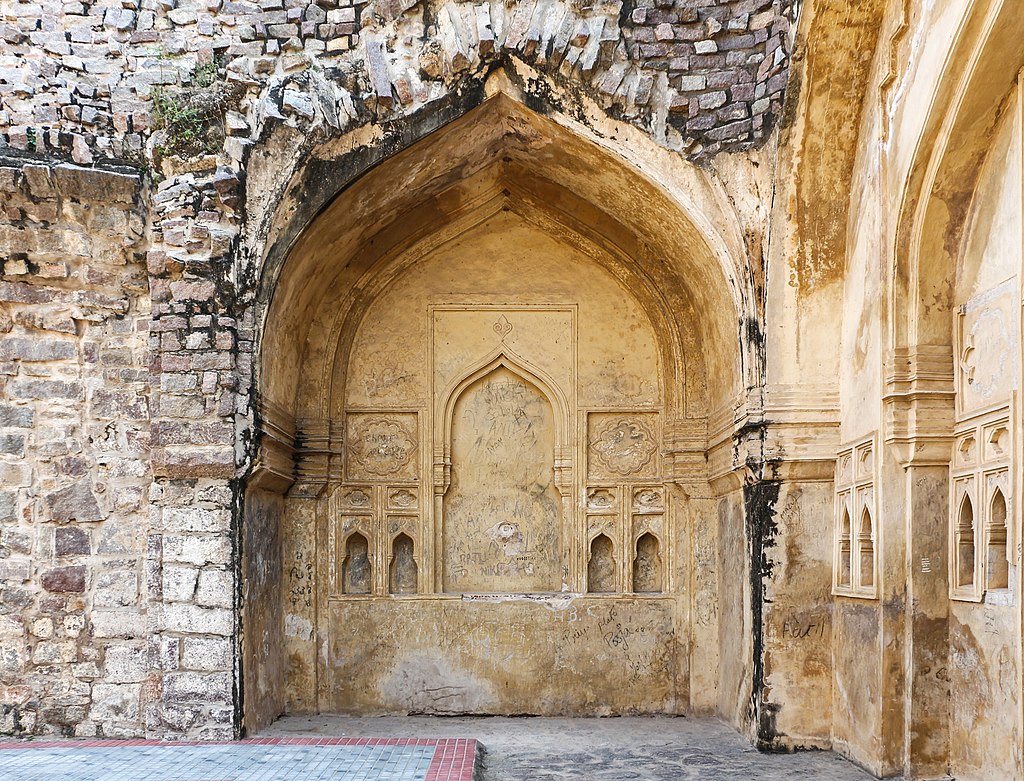
      The entrance to the huge fort of Golconda is through the Bala Hissar Darwaza. There are various structures inside the fort. A new world opens before the eyes of the viewer who has entered the fort complex; with its fortifications, eight gates, mosques,mahals or palaces, baths, wells, arches , offices, step-ways, granary, royal armoury, fountainheads and gardens. One can visualise a bustling medieval royal centre with kings, nobles, ordinary people, elephants,horses and soldiers. It is like a journey through time.The acoustic system of the fort is unique and was used for vital communication. The story of Golconda as a capital is that of the Qutub Shahi sultans or kings. Though originally a mud fort existed built by the Kakatiyas on the Golla Konda or cowherd's hill, the area finally came to the Bahamanis who appointed a Qutub Shahi viceroy who later came to rule the area, Sultan Quli. The area was modified by the additions of new structures which changed it in ways whose remnants are still visible.

Forst Map - panoramio.jpg

Golconda Fort map.

By Qasim Al Khuzaie, CC BY 3.0, https://commons.wikimedia.org/w/index.php?curid=54066461


        The fortified hill on which the Bala Hissar stands,  a baradari is 130 m above the ground level. The defensive wall of the outer area protects the whole city which is about 2.5 km long. This enclosed a Naya Qila or New Fort built by Abdullah Qutub Shah in 1624 which projects to the north-east. This wall has a height of 10m with eight strong gates, four of which are still open. Fateh Darwaza is the gate through which Aurangzeb's forces entered,the Mecca Drawaza was built in 1590, the Banjara Darwaza leads to the tombs and the Moti Darwaza. Most bastions are semi-circular except one which has nine lobes,projecting out of the  Naya Qila. To the west of the Fateh Darwaza, is the Bala Hissar Darwaza , the entrance to the second line of fortification walls that surround the hillock. On entering , on the right is the Nagina Bagh, where the royal ladies would stroll in the past. These two gates are connected by a road on either side of which are many structures in different states of preservation.They include remains of palaces,baths,bazaars,mosques etc. Merchants,officials,teachers,ordinary people lived here. A triumphal arch is present before the Bala Hissar Darwaza. To the north east is the Jami mosque built by Sultan Quli Qutub-ul-mulk in 1518. In front of the Bala Hissar Darwaza towards the east are two  arched structures called Habshi Kamans on top of which were rooms where were posted the Abyssinian guards of the Sultans.

Golconda fort from top.jpg  
Fortifications, Golconda Fort.

By Rashmi.parab - Own work, CC BY-SA 3.0, https://commons.wikimedia.org/w/index.php?curid=21747589


File:Golkonda Fort 2, Hyderabad.JPG

Fortifications, Golconda Fort.

By Gowthama Poludasu (Own work) [CC BY-SA 3.0 (http://creativecommons.org/licenses/by-sa/3.0)], via Wikimedia Commons

 
Golkonda 01.jpg

Entrance to the Fort, Bala Hissar Darwaza.

By Anupamg - Own work, CC BY-SA 3.0, https://commons.wikimedia.org/w/index.php?
curid=21148479
Golconda fort, andra pradesh exit.JPG

Naqqar Khana,Golconda Fort.

By Pravina - Own work, CC BY-SA 3.0, https://commons.wikimedia.org/w/index.php?curid=21179621


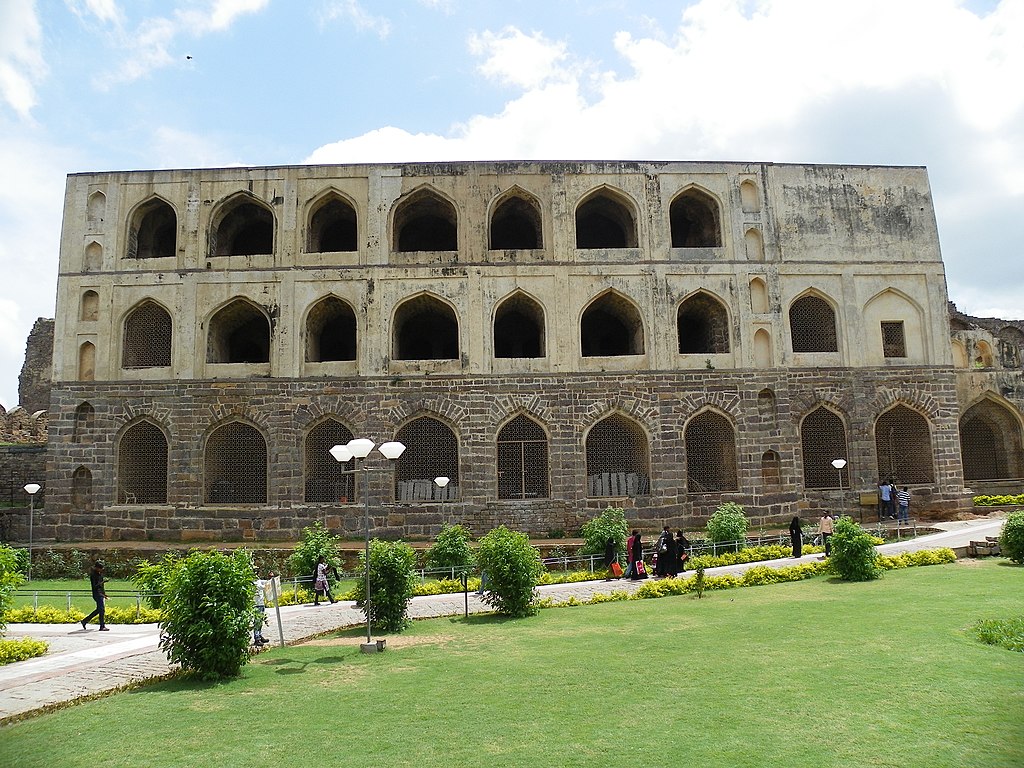
    Halfway up the hill are seen double walls which form the third line of defence. On the left side one comes across palaces,harem apartments,mosques, arsenal or Silahkhana, ambarkhana or granary and open space and parks on the right. The Silahkhana has three storeys and is a granite structure. Some muskets are still present. These could also be those left behind by Aurangzeb's army and the building is actually  the administrative building of the Qutub Shahis. The Ambarkhana was the royal granary at the Golconda Fort. A Persian inscription here mentions that it was built by Khairat Khan, a minister of  Abdullah Qutub Shah,in 1642.


Golconda Fort 012 - Ambar Khana.jpg

Ambarkhana or granary, Golconda Fort.

By Bernard Gagnon - Own work, CC BY-SA 3.0, https://commons.wikimedia.org/w/index.php?curid=34159864

Steps of Golcnda.jpg

Steps at the Fort.

By Vineeth Eguri - Own work, CC BY-SA 3.0, https://commons.wikimedia.org/w/index.php?curid=28029939


Golconda Fort 4.JPG

Silakhana or royal armoury/Administrative building, Golconda Fort.

By Karthik Uppaladhadiam - Own work, CC BY-SA 3.0, https://commons.wikimedia.org/w/index.php?curid=21591947


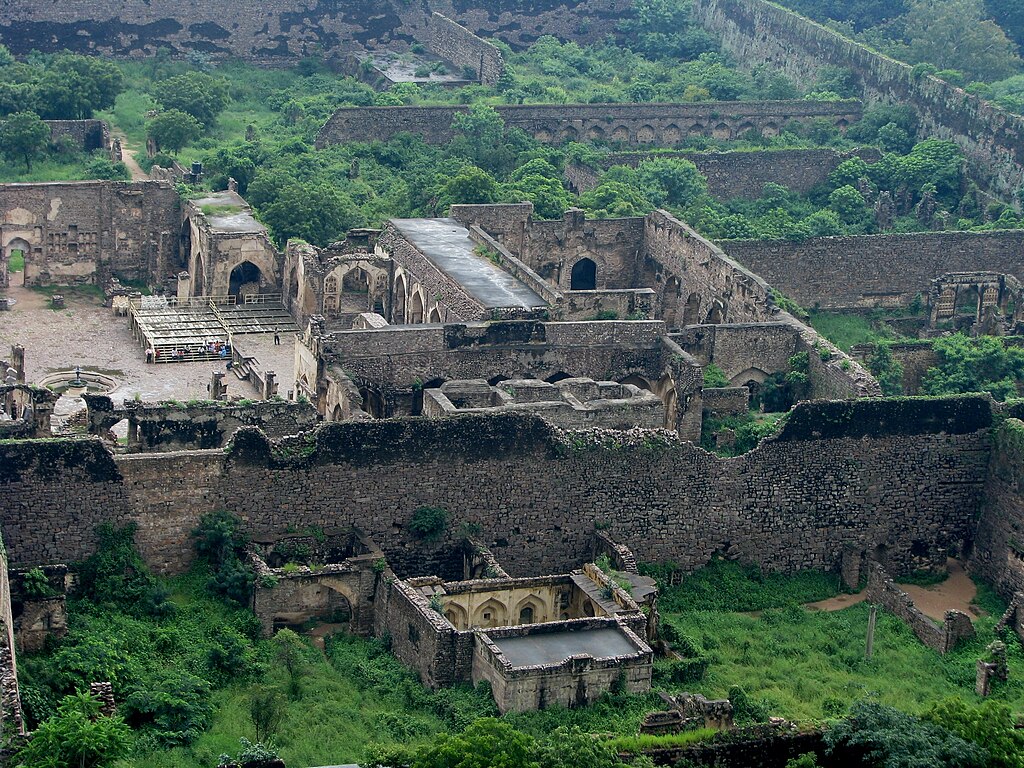
   Ahead of the Silahkhana or administrative building to the left  are seen ruins of palaces of which some rise to 5-6 floors. Huge halls were present with fountains and tanks,including the upper floors. In their heyday they must have had curtains, carpets, with lamps and chandeliers abounding with servants amongst the noblemen who lived in them. Below the royal palaces by the eastern wall is a plain space called the Maidan or the Jilu Khana-e-Ali. At the centre is a mosque now in ruin; originally everyday the Sultan would be at a jharoka or window behind the mosque and the armies would march past and not just salute the ruler but also pay homage to God.

   The Diwan Mahal is a palace where Mir Jumla used to reside where later Akkanna and Madanna lived.
   Top View.jpg

Remains of palaces,Golconda Fort.

By Smkeshkamat - Own work, CC BY-SA 3.0, https://commons.wikimedia.org/w/index.php?curid=28388709

Golconda 032.JPG
  
 Palace complex, Golconda Fort.

By Sanyam Bahga - Own work, CC BY-SA 3.0, https://commons.wikimedia.org/w/index.php?curid=18589857


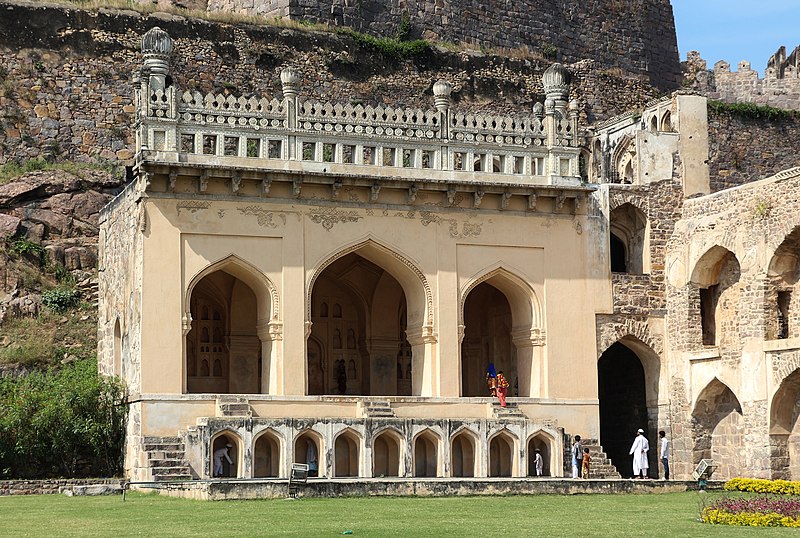
 Some way below the Bala Hissar is a mosque built by Sultan Ibrahim Qutub Shah. To its left is the now barren Hall of Justice or Dad Mahal. Narrow staircases lead to a flat roof with a carved stone throne, called Tanashah ki gaddi where the sultans used to sit to enjoy the evening breeze, look over the area and listen to music from the royal courtesans' singing some distance away ,so it is believed. Given the superb acoustic system that was present at the time, one can just believe the same !

File:Golconda fort mosque, Hyderabad.jpg

Sultan Ibrahim's mosque,Golconda Fort.

By Linda N. [CC BY 2.0 (http://creativecommons.org/licenses/by/2.0)], via Wikimedia Commons

Golconda Fort View 2.jpg

Decorative motifs in stucco,Sultan Ibrahim's mosque,Golconda Fort.

By Ashis Jain - Own work, CC BY-SA 3.0, https://commons.wikimedia.org/w/index.php?curid=21641116


Ruins of golkonda fort, Hyderabad, India.jpg

 Archways, Golconda Fort.


By Joydeep - Own work, CC BY-SA 3.0, https://commons.wikimedia.org/w/index.php?curid=19274044


        The Taramati Mosque is located outside of the palace area. It was used by the Sultans and nobles at the Golconda Fort.

File:Golconda Fort - Taramati Mosque 02.jpg

Taramati mosque, Golconda Fort.

By Bernard Gagnon (Own work) [GFDL (http://www.gnu.org/copyleft/fdl.html) or CC BY-SA 3.0 (http://creativecommons.org/licenses/by-sa/3.0)], via Wikimedia Commons


   The fort has many other important structures. An Ashurkhana close to the Fateh darwaza of the fort was built by officer called Mallad of Sultan Abdullah Qutub Shah's army. The ashurkhana is called Sartooq-e-Hussaini.


    A mosque built by a poet Mullah Khiali is situated in the Naya Qila and is called Masjid-e-Mullah Khiali. Other mosques include the Masjid-i-Safa or Jami Masjid built by Sultan Quli. In 1668 a Hira mosque  was built near the Moti Darwaza after the establishment of a second diamond market during the reign of Sultan Abdullah Qutub Shah. A Bahmani mosque in the fort area was built by  Sultan Mohammad Shah Bahmani I during a halt at Golconda.


File:Ceiling of golkonda fort.JPG

A ceiling at the Fort.

By Barkha dhamechai (Own work) [CC BY-SA 3.0 (http://creativecommons.org/licenses/by-sa/3.0)], via Wikimedia Commons


      Just below the Bala Hissar is the Ramadas bandikhana where Kanchanna Gopanna or  Bhakta Ramadas  was imprisoned at the fort by the last king,Sultan Abul Hasan Tana Shah, for diverting money for a temple. He chiselled the figures of deities Rama, Sita and Lakshmana and worshipped them there. It is believed that due to his prayers, the deities appeared to Tana Shah in a dream and he was released.
                                                                       File:Carvings of Hanuman, Ram, and Lakshma inside the jail cell within Golconda Fort, in Hyderabad.jpg 
Carvings of the deities Hanuman, Rama, and Lakshmana  made by  Bhakta Ramadas when imprisoned.

By LASZLO ILYES from Cleveland, Ohio, USA (Indian Idol  Uploaded by Ekabhishek) [CC BY 2.0 (http://creativecommons.org/licenses/by/2.0)], via Wikimedia Commons

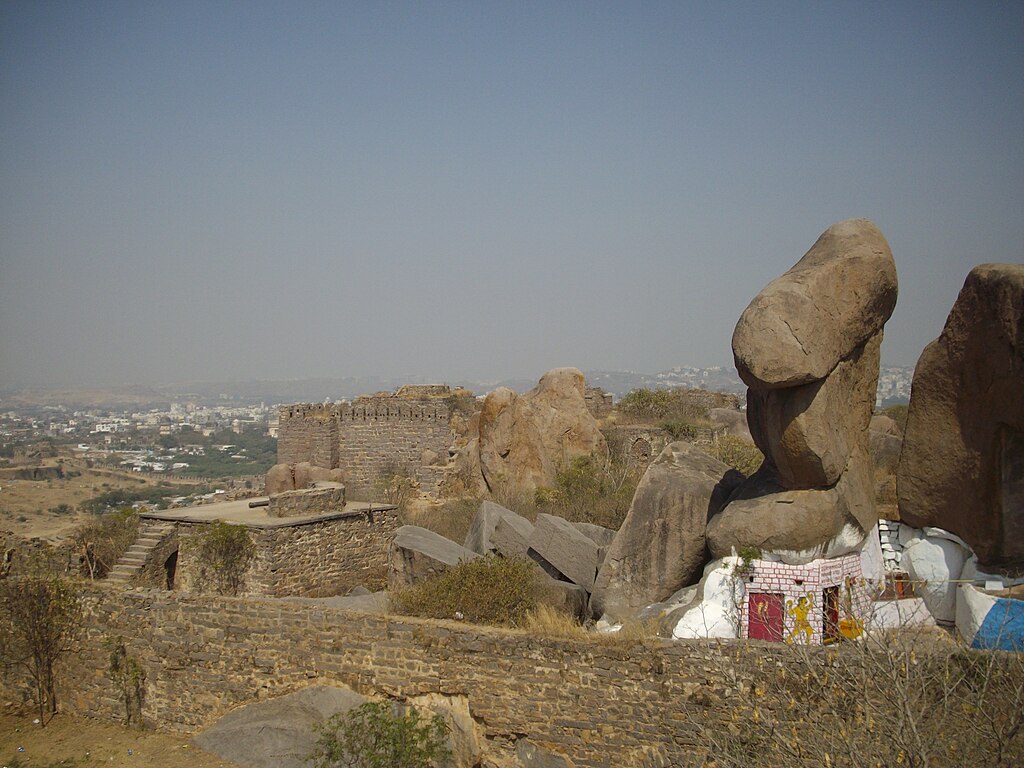
           Some distance from the acropolis is  the Mahankali temple,partially carved from rock,renovated by brahmins during the rule of the last Sultan, Tana Shah under the prime ministership of Madanna.  

Rock formation in Fort.JPG

Temple, Golconda Fort.


By Rudolph.A.furtado - Own work, Public Domain, https://commons.wikimedia.org/w/index.php?curid=5825174

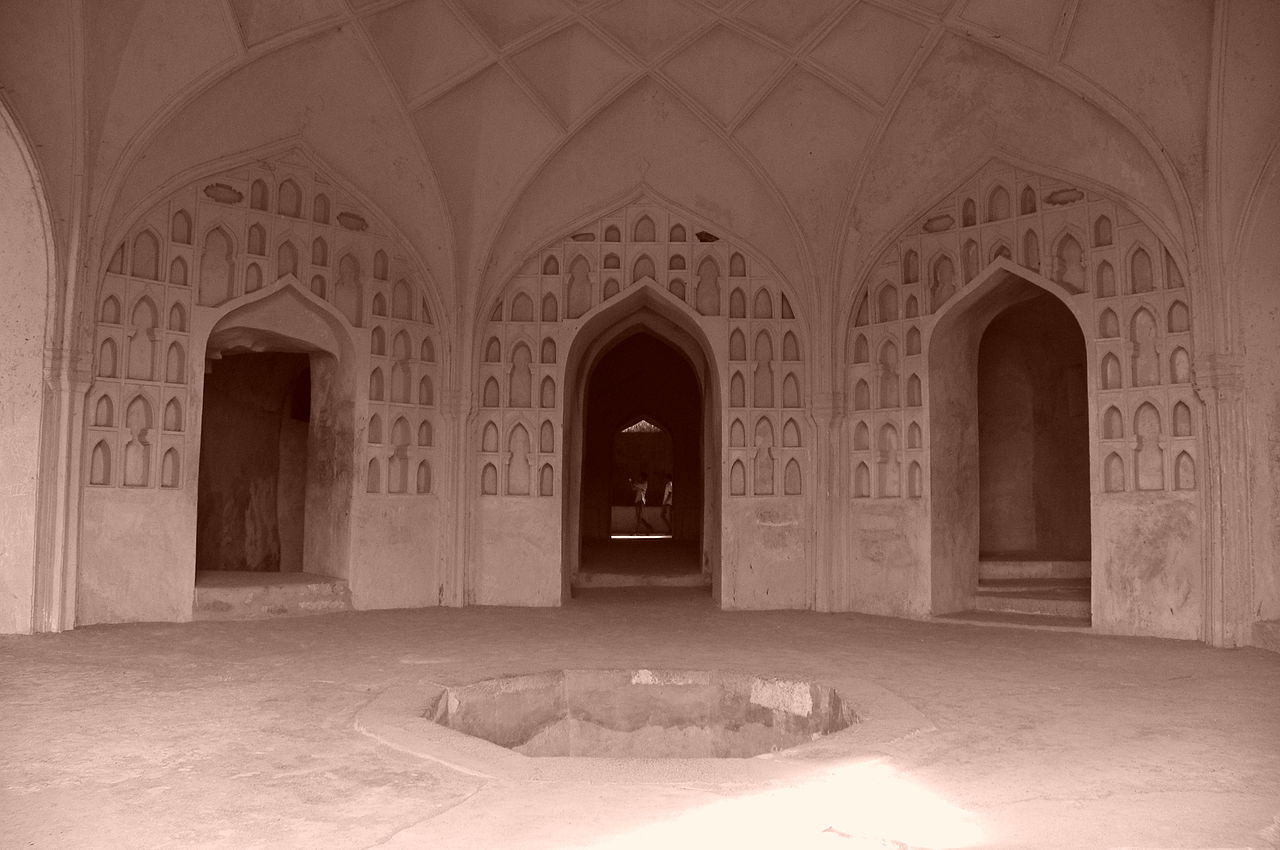
         The structure below has been designated as the Rani Mahal, originally made up of four floors according to some sources. 

Golconda Fort 49.JPG

Rani Mahal,Golconda Fort.

By Karthik Uppaladhadiam - Own work, CC BY-SA 3.0, https://commons.wikimedia.org/w/index.php?curid=21604502

File:Golconda Fort - Rani Mahal 05.jpg

Rani Mahal,Golconda.

By Bernard Gagnon (Own work) [GFDL (http://www.gnu.org/copyleft/fdl.html) or CC BY-SA 3.0 (http://creativecommons.org/licenses/by-sa/3.0)], via Wikimedia Commons

Golconda Fort 76.JPG

Arches and niches, Golconda Fort.

By Karthik Uppaladhadiam - Own work, CC BY-SA 3.0, https://commons.wikimedia.org/w/index.php?curid=21614897

Zanaana Mosque 01.jpg

Zenana mosque,Golconda Fort.

By Bernard Gagnon - Own work, CC BY-SA 3.0, https://commons.wikimedia.org/w/index.php?curid=34247133


          The water supply system kept the tanks full and the fountains active in all floors and levels. Durgam Tank, 5 Km form the Fort was the source of the water. By the side of the steep path made up of irregulars steps which lead to the Bala Hissar, is a water raising arrangement with a series of tanks at different levels. Some sources say that groups of oxens at different levels would pull huge leather buckets by rope and pulley to put into higher cisterns. On the way to the Banjara Darwaza towards the tombs in the north side is a stone and mortar tank built by Sultan Ibrahim Qutub Shah in 1560, the Katora Hauz whose water was filled through underground pipes; sometimes with rose water which added fragrance; specially for the Sultan.


     A mortuary bath structured on the lines of Persian/Turkish design is present where the royals were bathed before burials. Other structures in the Fort complex include the Dal badal chabutara, camel stables, a mint, Shamsheer kotha which was an armoury, a langar house and a dhobi ghat.

File:Well in golconda.JPG

Well,Golconda fort.

By Bhaskaranaidu (Own work) [CC BY-SA 3.0 (http://creativecommons.org/licenses/by-sa/3.0)], via Wikimedia Commons


Golconda... water pipe to the wall.JPG

Remains of water supply system, Golconda Fort.

By Bhaskaranaidu - Own work, CC BY-SA 3.0, https://commons.wikimedia.org/w/index.php?curid=21863841


File:Golconda Fort 65.JPG

Fountainhead,inside Golconda Fort.

By Karthik Uppaladhadiam (Own work) [CC BY-SA 3.0 (http://creativecommons.org/licenses/by-sa/3.0)], via Wikimedia Commons


Mortuary bath,Golconda Fort.

Pic : Isha Vatsa


File:Bala Hisar Pavilion.JPG

The acropolis, Bala Hissar,Golconda Fort.


By Santoshvatrapu (Own work) [CC BY-SA 3.0 (http://creativecommons.org/licenses/by-sa/3.0)], via Wikimedia Commons


References :
  1. The heritage of the Qutb Shahis of Golconda and Hyderabad/Nayeem,M.A,Hyderabad : Hyderabad Publishers,2006.
  2.  Marg, Vol XXXVII No:3, Bombay : Marg Publications.
  3. Hyderabad : a city in history/Khan, Raza Ali, Hyderabad : Zenith Services,1990.
  4. Art and architecture of Qutub Shahi times/Meena Kumari, V./Delhi : B. R Publishing Corporation,2014.


Posted by :


Soma Ghosh


Ⓒauthor

Monday, 20 March 2017

Bala Hissar : Golconda Fort's acropolis.


Bala Hissar : Golconda Fort's acropolis


      The Bala Hissar is the acropolis; at the topmost point at the Golconda Fort. The Golconda fort was a township in itself with the fort with its fortifications, bastions,gates,royal palaces, adminsitrative buildings,military offices,granary,arsenal mosques, ashurkhanas,dargahs,bazaars,hammams and roads. Sultan Quli named the area as   Muhammadnagar.  Golconda was the capital of the Qutub Shahis which later shifted to Hyderabad in 1591-2. However it became the capital again in 1656 when Sultan Abdullah Qutub Shah shifted there. 
     
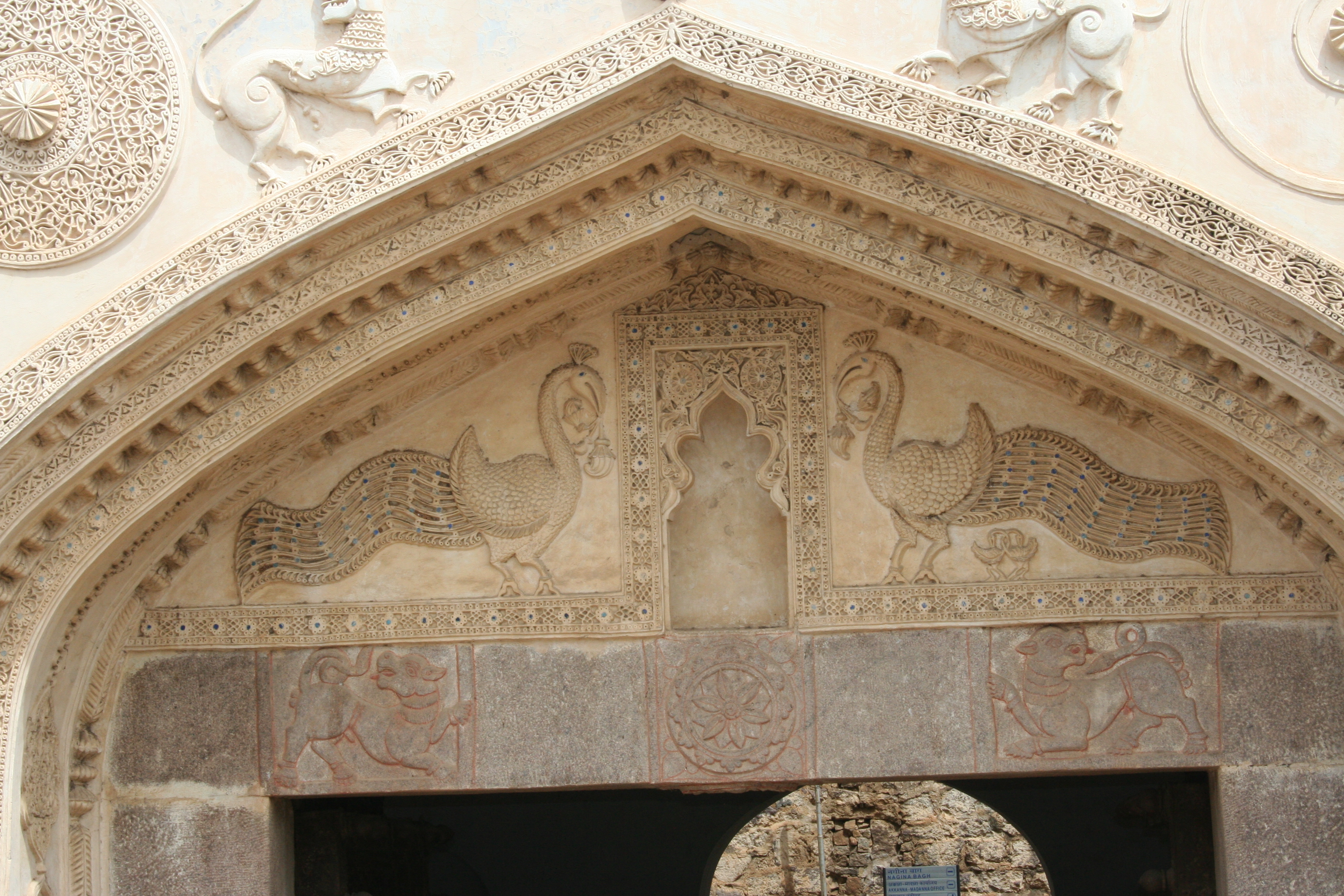
      The Bala Hissar area marks the inner area of the fort. The entrance is through the Bala Hissar Gate which shows Indo-Islamic design in stucco between the arch and lintel with mythical animals. It is the gate to the second line of fortification walls. The baradari at the top of the hillock, is commonly called Bala Hissar. It is double storied and can be reached after climbing more than 350 steps. It is on the topmost part of the fort about 130m above ground level  and is built by bricks and limestone with many big halls  which were used as assembly halls. The roof has an elevated structure which was the seat of the Sultan also called Tanashah ki gaddi. There is a deep well to the left. Toward the foothill used to be the harem. It is believed that the Sultan Mohammed Qutub Shah and Sultan Abdullah used to sit on this high point and listen to music wafting from a distance from the baradaris of Taramati and Premamati, royal courtesans. The acoustics of the fort were of a very advanced nature. A clap from below can be heard at the Bala Hissar on the top of the fort area. This was used as a communication system during the Qutub Shahi times.


Bala Hissar,Golconda Fort.

By Bernard Gagnon - Own work, CC BY-SA 3.0, https://commons.wikimedia.org/w/index.php?curid=34139140

Golkonda 01.jpg

Bala Hissar Gate,Golconda Fort.

By Anupamg - Own work, CC BY-SA 3.0, https://commons.wikimedia.org/w/index.php?curid=21148479


Image result for bala hissar golconda

Peacock motifs, Bala Hissar Gate, Golconda Fort.

By Smkeshkamat (Own work) [CC BY-SA 3.0 (http://creativecommons.org/licenses/by-sa/3.0)], via Wikimedia Commons

Image result for bala hissar golconda
Stucco work, Bala Hissar Gate, Golconda Fort.


By Bernard Gagnon (Own work) [GFDL (http://www.gnu.org/copyleft/fdl.html) or CC BY-SA 3.0 (http://creativecommons.org/licenses/by-sa/3.0)], via Wikimedia Commons


Muḥammad or Sultan Mahmud.jpg

Sultan Mohammad Qutub Shah, portrait,17th century.

By Golkonda Painters - http://www.britishmuseum.org/research/search_the_collection_database/search_object_details.aspx?objectid=265605&partid=1&searchText=mughal&fromADBC=ad&toADBC=ad&numpages=10&images=on&orig=%2fresearch%2fsearch_the_collection_database.aspx&currentPage=87, Public Domain, https://commons.wikimedia.org/w/index.php?curid=17783141

Image result for sultan abdullah qutb shah painting

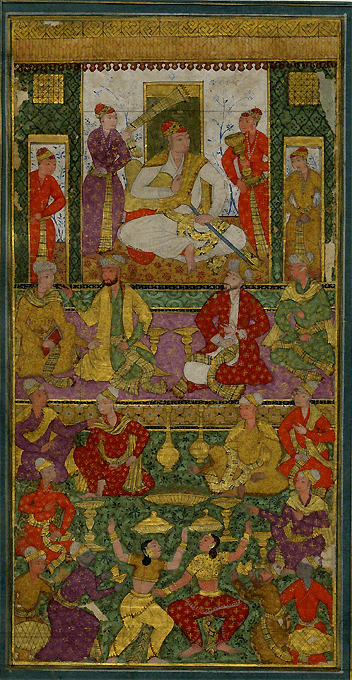
Sultan Abdullah Qutub Shah with dancers and attendants Golconda,painting,17th century. 

By Deccan School [Public domain], via Wikimedia Commons

References :


  1. wikipedia.org
  2. The heritage of the Qutb Shahis of Golconda and Hyderabad/Nayeem,M.A,Hyderabad : Hyderabad Publishers,2006.
  3.  Marg, Vol XXXVII No:3, Bombay : Marg Publications.


Posted by :


Soma Ghosh


©author


Wednesday, 28 December 2016

Hussain Sagar :  echoes of a sufiyana past

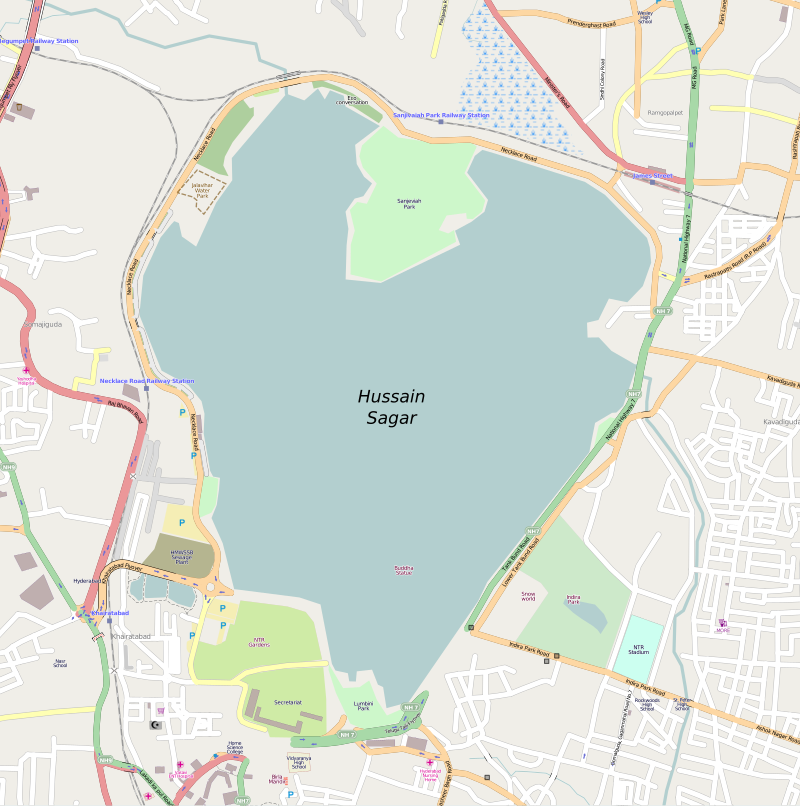
   The Hussain Sagar lies between the twin cities of Hyderabad and Secunderabad. It is a Qutub Shahi structure built in 1563 by Ibrahim Quli Qutub Shah and engineered by Hussain Shah Wali, a Sufi mystic. The lake is heart shaped. Built originally for the purpose of a tank near Golconda for irrigation and drinking water, its maximum depth is 32 feet, spread across an area of 5.7 square kilometres. 

Hussain Sagar Map.svg

Map of Hussain Sagar, Hyderabad,Telangana.

By OpenStreetMap - http://www.openstreetmap.org/, CC BY-SA 3.0, https://commons.wikimedia.org/w/index.php?curid=22643894


     Hussain Shah Wali was  a nephew of Khaja Bandenawaz, a famous Sufi saint of Gulbarga. He had been called to the royal court of the Qutub Shahis by  Sultan Ibrahim Quli Qutub Shah, as it was a practice to have a descendant of Khaja Bandenawaz for protection and well being of the state. Hussain Shah Wali also  cured him of illnesses. He was a peerzada and called Hazrat Khaja Hussain Shah Wali, a Sufi saint and is believed to have performed many miracles.He later became son-in-law of the Sultan after marriage to his daughter, Khairatunissa. The tank also provided a salubrious atmosphere for her during her illness period.


Hazrat Khaja Hussain Shah Wali

It took over three years to complete but remained unfilled for four years. The Sultan then directed Neknam Khan, a noble at his court to make channels from the River Musi to the tank, which was done and the tank was filled.


Hussain Sagar, 1932.

By Unknown - Unknown, Public Domain, https://commons.wikimedia.org/w/index.php?curid=34894212

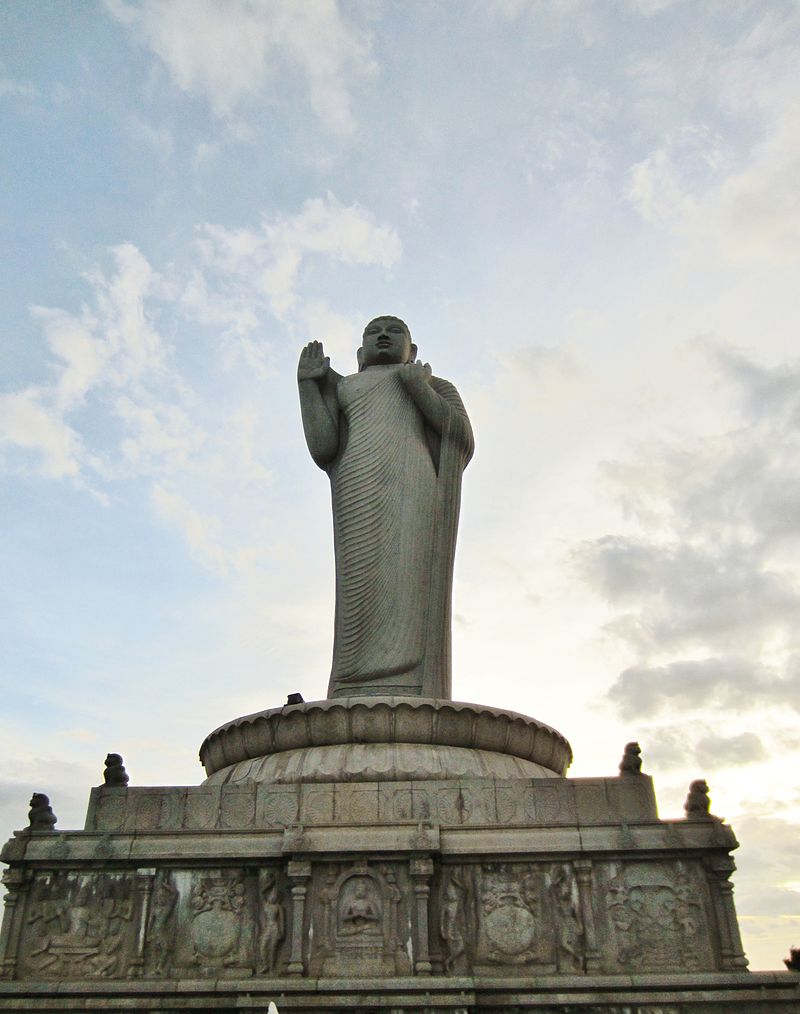
   There are many interesting structures around the lake. The lake surroundings have seen many modifications around it over the years. It was fed by the channels from the River Musi, a tributary of the Krishna and was perennially full of water. It was a source of drinking water before the Osman Sagar and Himayat Sagar were made. The monolithic giant statue of Lord Buddha is now standing majestically in the lake , installed in 1992. 

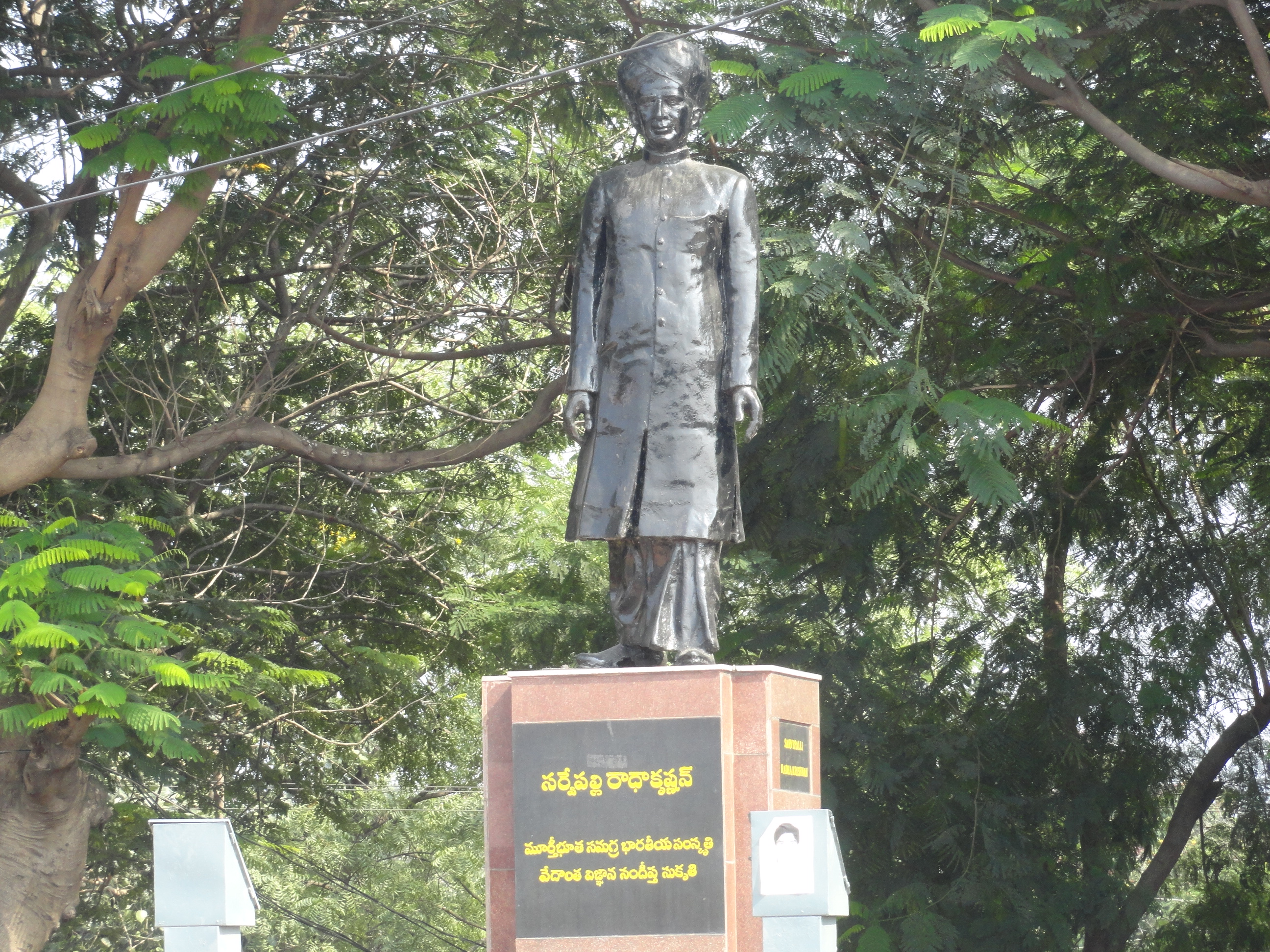
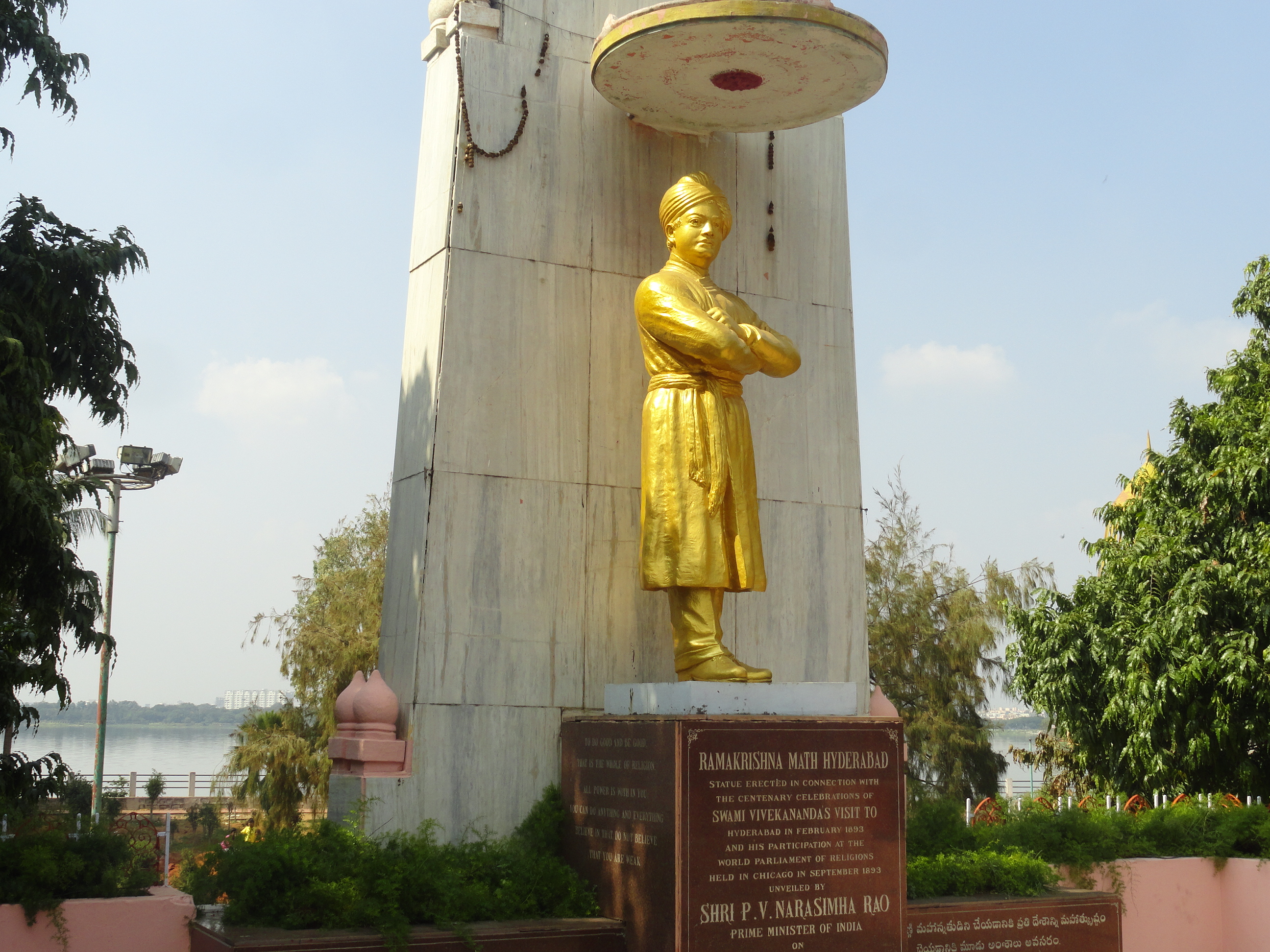
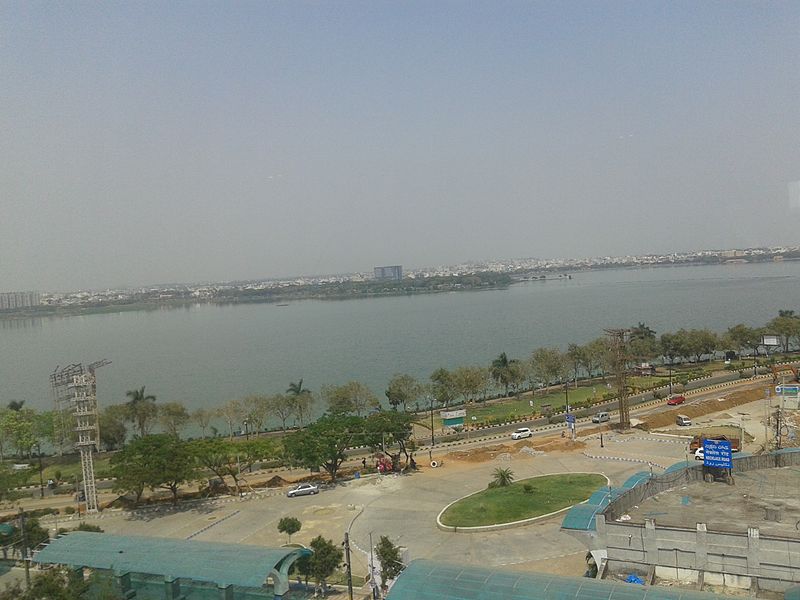
The Birla Temple, Sanjeevaiah Park,Lumbini Park, The NTR Gardens, Prasad's Imax, The Paton Tank of Pakistan, Saidani-ma's tomb, various statues of important personalities including Rudrama Devi, Dr.Sarvapalli Radhakrishnan, Asaf Jah VI  are present in the areas and roads around the lake. The road on one side is called the Tank Bund Road, the Tank Bund being the dam of the lake; the one on the other side is the Necklace Road. The Tank Bund Road was originally narrow, but was widened by Sir Mirza Ismail, Prime Minister of Hyderabad in 1946. The area was further beautified and statues of many important personalities  were installed by the Andhra Pradesh Government in 1987-88. The area is thronged by visitors and tourists. Regular sailing events are also held on the lake.  The largest flag of the country, the tricolour, was unfurled at the Sanjeevaiah Park on the 2nd anniversary of the formation of Telangana State, the 29th in India, in 2016. Efforts are on to conserve the lake and maintain its beauty.

Image result for image of tank bund road statues

Statue of Dr. S. Radhakrishnan on Tank Bund, Hyderabad.

By Bhaskaranaidu (Own work) [CC BY-SA 3.0 (http://creativecommons.org/licenses/by-sa/3.0)], via Wikimedia Commons


Hussainsagar2 hyd.jpg

Lake-view towards evening.

By Cephas 405 - Own work, CC BY-SA 3.0, https://commons.wikimedia.org/w/index.php?curid=4792856

Hyderabad lake from arial view - 1.jpeg

Aerial view, Hussain Sagar.

By Arunprakash - Own work, CC BY-SA 3.0, https://commons.wikimedia.org/w/index.php?curid=32178043

Budhdha Statue Lumbini Park.JPG

Buddha statue, Hussain Sagar Lake, Hyderabad. 

By Tusharg1993 - Own work, CC BY-SA 3.0, https://commons.wikimedia.org/w/index.php?curid=28193496

Image result for image of tank bund road statues

Swami Vivekananda statue, Tank Bund, Hyderabad.

By Bhaskaranaidu (Own work) [CC BY-SA 3.0 (http://creativecommons.org/licenses/by-sa/3.0)], via Wikimedia Commons


Necklace Road, Hyderabad.

By Naveenji at English Wikipedia - Own work, Public Domain, https://commons.wikimedia.org/w/index.php?curid=23038599


Image result for hussain sagar lake images

Hussain Sagar, Hyderabad.

By Poreddy Sagar (Own work) [CC BY-SA 3.0 (http://creativecommons.org/licenses/by-sa/3.0)], via Wikimedia
Commons

 File:Indian flag in Sanjeeviah park.jpg

Indian tricolour at Sanjeevaiah Park, Hyderabad.

By Mhdmzml (Own work) [CC BY-SA 4.0 (http://creativecommons.org/licenses/by-sa/4.0)], via Wikimedia Commons
Image result for hussain sagar lake images

Lake wetlands, Hussain Sagar, Hyderabad.

By Adityamadhav83 (Own work) [CC BY-SA 3.0 (http://creativecommons.org/licenses/by-sa/3.0)], via Wikimedia Commons


References :


  • Chandraiah, K/Hyderabad : 400 glorious years, Hyderabad : Information and Public Relations, 1996.
  • wikipedia.org


Posted by :

Soma Ghosh

Ⓒauthor

Tuesday, 29 November 2016

Golconda in art : images of royalty


       Golconda was one among the Sultanates of the Deccan during 16th -18th century India. Known all over the world for its fortifications, big arsenals, ruined palaces, gardens, fountains, pools, mosques and terraces and leader in diamond trade with expertise in cutting an polishing the stone; as it was available in the mines in the bed of the river Krishna. The hill fortress at a height of 400 feet above the ground, housed the king's soldiers, harem, treasury, courtiers and followers. The area within the fort also housed a population which grew too large and a new capital for the kingdom was made at Hyderabad by Sultan Mohammad Quli in 1591.

The kingdom extended over the Southern peninsula starting from the Godavari river upto the Cape Comorin and up to the Indian Ocean in the east.

The art of the Golconda kingdom and some of it's representations are elucidated for an idea of the art of the Golconda and Hyderabad school of Deccani painting. 

Deccani painting evolved when the Deccan Sultanates namely, Ahmadnagar, Bijapur and Golconda started producing paintings of great quality. There was a strong Persian influence on their art. However their art was distinct and has earned itself a unique place in the history of Indian painting. Deccani paintings were not dated or inscribed with the name of the painter as the Mughal ones. 

  Coming to the subject at hand, namely Golconda, it can be said that the Persianate character of their painting can be attributed to the fact that the first king, Sultan Quli had migrated from Persia to Bidar in 1478. The Qutub Shahis maintained close ties; which included matrimony with the Safavids and patronised poets and painters from Persia.

The typicality of Golconda paintings lies in its opulence and vitality which has an Indian flavour of richness.

File:Abdullah Qutb Shah.jpg
Portrait, Sultan Abdullah Qutub Shah of Golconda.

By Unknown - [flickr http://www.flickr.com/photos/thesandiegomuseumofartcollection/6125086876/in/photostream/], CC BY-SA 3.0, https://commons.wikimedia.org/w/index.php?curid=24570593

      The Kulliyat-e- Mohammad Quli Qutub Shah , a collection of the Sultan's poetry contains many illustrations which depict the Golconda school of painting. Iridiscent colours including bluish-purple, salmon-red,pricked gold surfaces are typically Golconda style.There are other astonishing and splendorous  examples too.

File:Illuminated Manuscript of the History of the Qutb Shahi Sultans of Golconda LACMA M.89.159.4 (2 of 5).jpg

Illuminated Manuscript of the History of the Qutb Shahi Sultans of Golconda LACMA , 17th century.

https://commons.wikimedia.org/wiki/File%3AIlluminated_Manuscript_of_the_History_of_the_Qutb_Shahi_Sultans_of_Golconda_LACMA_M.89.159.4_(2_of_5).jpg
See page for author [Public domain], via Wikimedia Commons

File:Illuminated Manuscript of the History of the Qutb Shahi Sultans of Golconda LACMA M.89.159.4 (3 of 5).jpg

Illuminated Manuscript of the History of the Qutb Shahi Sultans of Golconda LACMA , 17th century.

https://commons.wikimedia.org/wiki/File%3AIlluminated_Manuscript_of_the_History_of_the_Qutb_Shahi_Sultans_of_Golconda_LACMA_M.89.159.4_(3_of_5).jpgSee page for author [Public domain], via Wikimedia Commons


Illuminated Manuscript of the History of the Qutb Shahi Sultans of Golconda LACMA M.89.159.4 (1 of 5).jpg

Illuminated Manuscript of the History of the Qutb Shahi Sultans of Golconda,LACMA , 17th century.

By Image: http://collections.lacma.org/sites/default/files/remote_images/piction/ma-2794559-O3.jpgGallery: http://collections.lacma.org/node/177837, Public Domain, https://commons.wikimedia.org/w/index.php?curid=27254257

Illuminated Manuscript of the History of the Qutb Shahi Sultans of Golconda LACMA M.89.159.4 (4 of 5).jpg

Illuminated Manuscript of the History of the Qutb Shahi Sultans of Golconda LACMA , 17th century

By Image: http://collections.lacma.org/sites/default/files/remote_images/piction/ma-2794553-O3.jpgGallery: http://collections.lacma.org/node/177837, Public Domain, https://commons.wikimedia.org/w/index.php?curid=27254284


    After the death of Sultan Abdullah Qutub Shah. Abul Hasan ascended the throne. He was the son-in-law, ie. husband of the second daughter of Abdullah Qutub Shah. He was a follower of Shah Raju, and used to live in Gulbarga. Both of them came to Hyderabad. Shah Raju was a mystic and influenced the new court. Madanna, a Hindu became prime -minister and farmans (royal diktats) began to be issued in both Telugu and Persian. Urdu, Telugu and Arabic literature was patronised. There were influences in art too. Abul Hasan was nicknamed Tana Shah meaning king of taste. Many paintings of the Golconda school can be attributed to his time. The school was kept alive even after the defeat of Tana Shah in 1687 to Aurangzeb.The Mughal governors and local aristocracy engaged painters to work for them.


Visit of Sufi singer Shir Muhammad to Abul Hasan Qutb Shah, later Golconda school,1720.
By Govardhan II - http://expositions.bnf.fr/inde/grand/exp_031.htm, Public Domain, https://commons.wikimedia.org/w/index.php?curid=19082077


Akbar Shah, son of the Deccani saint Shah Raju (6124544567).jpg


Akbar Shah, Son of saint Shah Raju,17th century.


By thesandiegomuseumofartcollection - Flickr, Public Domain, https://commons.wikimedia.org/w/index.php?curid=38309515


Lady with the Myna Bird.jpg

Lady with a myna bird, early 17th century,Golconda.

By Deccan School - http://www.harekrsna.com/sun/features/12-11/features2319.htm, Public Domain, https://commons.wikimedia.org/w/index.php?curid=21077969

Durbar of Eighteen Princes.jpg

Durbar of eighteen princes, Qutub Shahi dynasty,17th century.

By Unknown - http://www.asia.si.edu/collections/singleObject.cfm?ObjectNumber=F1997.29, Public Domain, https://commons.wikimedia.org/w/index.php?curid=24823741
References :


  • Khan, Nazirul-Islam/Guide to Golconda, Bombay : Thacker & Company Limited,1941.
  • Zebrowski, Mark/Deccani painting, New Delhi : Roli Books,1983.


Posted by :


Soma Ghosh


© author