Showing posts with label Aurangzeb. Show all posts

Friday, 26 May 2017

Hyderabad's history :the Mughal connection


Hyderabad's history : the Mughal connection


         The Mughals tried to capture Golconda on two occasions. First in the year 1656, and then in the year 1687. Aurangzeb attacked  Golconda for the first time during the reign of Sultan Abdullah Qutub Shah. At that time his prime minister was Mir Muhanmmad Sayeed Mir Jumla. He was a very able person and under him a large part of the Karnatak province was annexed to the Golconda kingdom. However due to certain circumstances,  son of Mir Jumla was imprisoned by the Sultan. This led to a misunderstanding between them. Mir Jumla then appealed to Aurangzeb for release of his son. This gave him an opportunity to attack Golconda.

 Sultan Abdullah had to release Mir Jumla's son and pay a heavy indemnity in offer for peace. He also gave his daughter in marriage to Aurangzeb's eldest son.

 Sultan Abdullah Qutub Shah died in 1672. He was succeeded by his son-in-law Abul Hassan. During his rule Aurangzeb again attacked Golconda and was victorious in 1687. The siege had lasted for 8 months. Sultan Abul Hasan Tana Shah was taken prisoner and kept at Daulatabad Fort where he died in 1699.

Mughal amir horseback large c hi.jpg

Mughal amir on horseback,painting,17th century.

By Mughal School - bridgeman berlinfrom the Large Clive Albumhttp://www.art-prints-on-demand.com/a/mughal-school/a-mughal-amir-on-horsebac.html, Public Domain, https://commons.wikimedia.org/w/index.php?curid=16873985

     Kilich Khan was an important commander in the Mughal army. His actual name was Hajji Nawab Khwaja Abid Khan Siddiqi Bayafandi. He was given the title Kilich Khan by Mughal Emperor Shah Jahan. He lost his life in the battle for Golconda. His son was Ghaziuudin Khan Firuz Jung. He was made Subahdar of Gujarat Subah  during the reign of the Mughal Emperor Bahadur Shah I.

      In 1690s, Ghaziuddin Khan had founded a madarsaMadarsa Ghaziuddin Khan named after him. It became  Delhi College which eventually paved way for the present Zakir Hussain College, under University of Delhi.In 1986, it shifted to a new building outside Turkman Gate; the old structure in the Madrasa Ghaziuddin complex  still houses a hostel for the college and also has Ghaziuddin's mausoleum who had died in Ahmedabad in 1710.  His son was the famous Mir Qamar-ud-din Khan Siddiqi, Asaf Jah I the first Nizam of Hyderabad who was born to Ghaziuddin Khan and Wazirunnisa Begum at Agra in 1671.The name Mir Qamaruddin Khan was given by Emperor Aurangagzeb.


Kilich Khan, Mughal,painting, 1900,Smithsonian collections.

By Mughal dynasty - http://www.asia.si.edu/collections/singleObject.cfm?ObjectNumber=S1986.441, Public Domain, https://commons.wikimedia.org/w/index.php? curid=18230169


        When Mir Qamaruddin Khan was six the emperor gave him a mansab. He grew up to be a skilled warrior. He began to join his father in battle when he was still young. At 17 he joined in the assault at the Fort of Adoni. At 19, he was given the tilte Chin Fateh Khan by Aurangzeb.AT 20 was given the title of Chin Kilich Khan after the siege of Wagingera Fort. By 26 he was Commander-in-chief and Viceroy at Bijapur. He was later Viceroy at Malwa and finally of the Deccan. 


     After Emperor Aurangzeb died the Mughal empire began to lose its grip and was on the decline. Lot of confusion followed. Farukhshiyar who was Mughal emperor for some time gave him the title of Nizam-ul-mulk Fateh Jung. Later Emperor Muhammad Shah gave him the title Asaf Jah.

Emperor Farrukhsiyar Bestows a Jewel on a Nobleman.jpg


Emperor Farukhshiyar,painting,18th century.

By Attributed to Chitarman II (Kalyan Das) (active ca. 1700–45) - http://www.metmuseum.org/Collections/search-the-collections/60050361#fullscreen, Public Domain, https://commons.wikimedia.org/w/index.php?curid=18138484


     When Qamaruddin Khan was the subahdar of Malwa he had stated asserting himself.  After the death of Emperor Muhammad Shah, Farukhshiyar the sixth of Aurangzeb's successors  called him to take on the Sayyid borthers but Farukhshiyar was killed in the strife. Mir Qamaruddin Khan was made vizier in the court of Muhammad Shah but got disgusted soon and resigned his post in 1724 and marched towards the Deccan, Mubariz Khan, the subahdar of Deccan, who had been appointed by Farukhshiyar, refused to vacate and opposed him; a battle followed at Shakarkhleda at Berar. Mubariz Khan was killed. The emperor gave him the title Asaf Jah, sent him jewels and an elephant. He was the Viceroy of the Deccan and the Mughal authority in the Deccan. In 1725 the Marathas demanded chauth (a tax)  but the Nizam refused. A battle took place in 1727 near Nasik with Peshwa Bajirao. The Nizam also sent his troops to the aid of emperor Muhammad Shah to combat Nader Shah from Persia.The combined troops could not face the superior weapons and war tactics of the opposing forces. It is believed that the words of Asaf Jah I convinced him to stop his relentless massacre of Delhi.


Asaf Jah I ruled his territory well. In 1742 the British sent him him a hamper with goodies like 
a gold throne,silver threaded silk from Europe,yards of velvet, brocades,Persian carpets,rose 
water bottles, rose water etc. In return he sent a horse, a piece of jewellery and asked them not
to print their own currency. The British complied with the same. He died in 1748. Nizam-ul-mulk is well remebered 
for laying the foundation of the Hyderabad State His descendants ruled as the Nizams of Hyderabad
of the Asaf Jahi dynasty till the Indian Independence.


Asaf Jah I, Nizam of Hyderabad.jpg

Portrait, Nizam-ul-mulk,Mir Qamaruddin Khan,Asaf Jah I.

By Unknown - 1, Public Domain, https://commons.wikimedia.org/w/index.php?curid=1022094


References :

  • Hyderabad : a city  in history/Khan, Raza Ali, Hyderabad : Zenith Services,1990.
  • wikipedia.org

Posted by

Soma Ghosh

Ⓒ author

Monday, 15 May 2017

Seige of Golconda : end of an era

Siege of Golconda : end of an era


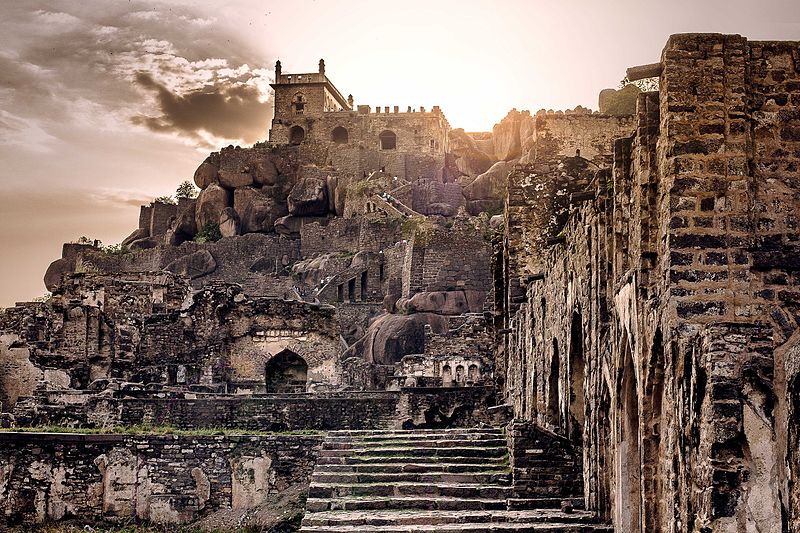
  The last ruling sultan of Golconda was Abul Hasan Tana Shah. By 1687 the Mughal forces had already conquered two Deccani kingdoms the Adil Shahi and Nizam Shahi sultanates with their capitals at Bijapur and Ahmadnagar respectively. in January,1687, Emperor Aurangzeb led the Mughal forces to capture the Golconda Fort. The siege lasted eight months. Golconda Fort was very strong fort with many bastions. The walls were made of granite.There was an excellent acoustic system in place for communication. The front gate had spikes to stop the elephants. Golconda was the only centre for diamonds at that time with the Kollur mine under them which has given the world many famous gems !


File:The Mighty Golkonda.jpg

Golconda Fort.

By Thariqmirza94 (Own work) [CC BY-SA 4.0 (http://creativecommons.org/licenses/by-sa/4.0)], via Wikimedia Commons

   The painting below shows Aurangzeb with attendants supervising cavalry and artillery as they attack the fortified city in the background. A breach has been made in the sandstone walls which the Mughal troops are traversing. The painting is from the Anne S.K. Brown Military Collection at the Brown University Library, Rhode Island, USA. The Mughals had finally entered the fort by bribing a Qutub Shahi official, Abdullah Panni, who opened a khirki in the Fateh Darwaza at the fort.


File:Emperor Aurangzeb at the Siege of Golconda, 1687.png

Aurangzeb at the siege of Golconda,painting,18th century.

See page for author [Public domain], via Wikimedia Commons


     The Mughal forces were driven by Ghaziuddin Khan Firuz Jung who was to bombard the fort's strong wall with cannons. The Fateh rahbar and Azhad-e-paikar were used. The cannon balls were heavy and used to shoot, during the siege. Kilich Khan, father of Ghaziuddin also took part in the siege. He was an experienced commnader of the Mughals. Munawwar Khan, the Mughal admiral ensured food and supply of weapons to the invading forces. Shaista Khan, Murshid Quli Khan and Ibrahim Khan were commanders in the Mughal army who positioned soldiers all around. Abdul Razzak Lari, also called Mustafa Khan from the Golconda front was a brave soldier who defended the fort during the siege and fell down seriously wounded at Nagina Bagh. He was later nursed back to health on the orders of Emperor Aurangzeb. He is well-remembered for his loyalty to Sultan Abul Hasan Qutub Shah.


Kilich Khan, Mughal commander,painting.

By Mughal dynasty - http://www.asia.si.edu/collections/singleObject.cfm?ObjectNumber=S1986.441, Public Domain, https://commons.wikimedia.org/w/index.php?curid=18230169


Elephant with mahout, Mughal, painting, 18th century.

By Unknown (production) - http://collections.vam.ac.uk/item/O73158/painting/, Public Domain, https://commons.wikimedia.org/w/index.php?curid=17701060

Nawab Sháyista Khán.jpg

Shaista Khan,Mughal commander,painting.

By Mughal Style - http://www.britishmuseum.org/research/search_the_collection_database/search_object_details.aspx?objectid=231822&partid=1&searchText=mughal&fromADBC=ad&toADBC=ad&numpages=10&images=on&orig=%2fresearch%2fsearch_the_collection_database.aspx&currentPage=34, Public Domain, https://commons.wikimedia.org/w/index.php?curid=17774211


  The siege lasted for eight months. The Qutub Shahis defended their fort to the maximum. Sultan Abul Hasan Tana Shah was in no mood to surrender, even though one of his commanders Muqarrab Khan changed loyalties. High intensity rockets were fired on the Mughal camps around the fort, from inside. The Mughals face many difficulties in capturing the fort. Cannon fire from the Golconda fort deterred the Mughal forces. Kilich Khan,long time commander and father of Ghaziuddin Firuz Jung, died during the siege.  

    However they did not give up. When supplies arrived they would start fresh attacks. Finally they could enter the fort when they could bribe a Qutub Shahi official Sarandaz Khan to open a gate by which the soldiers entered the fort, lead by Ghaziuddin Firuz Jung. The Sultan was captured and so was the Kollur mine by the Mughals. The Sultan was taken to Daulatabad fort. Some important diamonds were handed over to Emperor Aurangzeb which included the Noor-ul-Ain, Kara Diamond, Hope diamond, Dariya-e-noor and the Regent diamond. Mir Qamaruddin Khan, son of Ghaziuddin Firuz Jung became the viceroy, also called Asaf Jah I as Ghaziuddin Firuz Jung had died of natural causes. He was the viceroy of the Deccan appointed by the Mughals. He was given the title Chin Kilich Khan by emperor Aurangzeb in 1690, Nizam-ul-mulk by Farukhshiyar in 1713 and Asaf Jah by Muhammad Shah in 1725. He  started the line of Asaf Jahis or the Nizam rule in the Hyderabad-Deccan.


Mir Qamaruddin Khan, Asaf Jah I, Viceroy of the Deccan,painting, 1800.

By Unknown - 1, Public Domain, https://commons.wikimedia.org/w/index.php?curid=40816594


References :

  • History of the Qutub Shahi dynasty/Sherwani,H.K,New Delhi : Munshiram Manoharlal,1974.
  • M.A.Nayeem/The heritage of the Qutub Shahis of Golconda and Hyderabad,Hyderabad: Hyderabad Publishers,2006.
  • wikipedia.org

Posted by

Soma Ghosh

Ⓒ author
Monday, 24 April 2017

Sultan Abul Hasan ; last ruler of Golconda

Sultan Abul Hasan  : last ruler of Golconda


          Sultan Abul Hasan  was the last ruler of the Qutub Shahi dynasty, before the Mughal seige of Golconda in 1687. After the rule of Sultan Ibrahim Qutub Shah, his son Sultan Mohammed Quli Qutub Shah ruled from 1580-1611,who built the Charminar and established the new city of Hyderabad. He wrote poetry in Persian,Telugu and Urdu.He was followed by Sultan Muhammad Qutub Shah, his son-in-law and nephew who ruled between 1611-25. 


Muḥammad or Sultan Mahmud.jpg

Sultan Mohammad Qutub Shah,portrait,17th century.


By Golkonda Painters - http://www.britishmuseum.org/research/search_the_collection_database/search_object_details.aspx?objectid=265605&partid=1&searchText=mughal&fromADBC=ad&toADBC=ad&numpages=10&images=on&orig=%2fresearch%2fsearch_the_collection_database.aspx&currentPage=87, Public Domain, https://commons.wikimedia.org/w/index.php?curid=17783141

      Sultan   Mohammad Qutub Shah was the adopted son of Mohammad Quli and son of Mirza Muhammad Amin who died when Mohammad Quli was Sultan. He was married to Hayat Baksh Begum, daughter of Mohammad Quli. He had subdued Pratap Shah, the ruler of Bastar who acknowledged his supremacy. He was  a peace oriented king and tried to strengthen ties with Bijapur, and Ahmadnagar . During his reign Persian  language and culture flourished. Proto-urdu got a fillip. The Mecca Masjid was planned during his time. European factories already existed in the Golconda kingdom. The number of products being handled increased to include not just painted/printed cloth like qalamkari,cotton yarn, indigo etc. but also porcelain, silk, alum, brass etc. Mohammad Qutub Shah decided to take back the leases from the Dutch and established his own government's control on them. In fact that the European merchants competed among themselves to trade in the Coromandel coast and the Golconda kingdom.

Image result for sultan abdullah qutb shah wiki commons

Sultan Abdullah,painting,17th century.

By Unknown - [flickr http://www.flickr.com/photos/thesandiegomuseumofartcollection/6125086876/in/photostream/], CC BY-SA 3.0, https://commons.wikimedia.org/w/index.php?curid=24570593

   Sultan Abdullah Qutub Shah was Sultan Muhammad's son. He was born in 1614 and the next and the seventh ruler of Golconda. After he ascended the throne he was congratulated by Ibrahim Adil Shah of Bijapur and Murtaza Nizam Shah of Ahmadnagar by their envoys. Shah Abul Hasan and Mir Jafar; Prince Khurram (later Shah Jahan of the Mughal dynasty) sent Ikhlas Khan. Abul Hasan knew many languages and was  fond of poetry and music. Sultan Abdullah Qutub Shah had to enter a treaty with the Mughal emperor in 1636. By this he became Mughal vassal partially. His coins were to be struck in the name of the Mughal emperor. However in 1655 Shahjahan ordered collection of arrears or pesh kash. The Mughal forces entered Hyderabad and Golconda in 1656. Hayat Baksh Begum spoke to Aurangzeb and asked for pardon for her son. Abdullah sent jewels,elephants,gold, horses etc. He captured Vellore in 1652. The Mughals forced him into accepting strict conditions and a matrimonial alliance by marrying his daughter,Padshah Bibi Sahiba to Aurangzeb's eldest son,Muhammad Sultan Mirza. During his reign European trade flourished in the kingdom.He ruled between 1626-72. 

    He was followed by Abul Hasan, who was the son-in-law of Abdullah Qutub Shah, being married to his eldest daughter. Sultan Abdullah had three daughters and had no male heir.  One was married to Aurangzeb's son, Mohammad Sultan. However Mohd Sultan sided Prince Shuja during accession to the Mughal throne and as arrested and died later in prison in 1677. So he could not be made Sultan. Syed Muzaffar, a nobleman and general went to Shah Raju's khankhah and took Abul Hasan to the palace and proclaimed him Sultan in April 1672. He was married to the Sultan's third daughter. Syed Muzaffar was made Mir Jumla. He was later replaced by his secretary, Madanna. Madanna got appointed his brother Akkanna who became minister-in-charge of the armed forces. When Abul Hasan took over as Sultan the kingdom extended from outer region of Gulbarga and Bidar in the west to Vishakhapatnam in the north east to San Thome south of Madaras(now Chennai). Along with Madanna he tried to fortify his territory on the east coast. He had visited Vijayawada to see the Kondapalli fort.    Sultan Abul Hasan, who used to sing well, was called Tana Shah, a nickname given to him by his teacher Sufi saint, Hazrat Shah Raju Qattal, who was eighth in lineage to Banda Nawaz Gesudaraaz of Gulbarga. He had predicted that Abul Hasan would rule for 14 years. Sultan Abul Hasan ruled from 1672-1686.

     His reign was one of popularity. He was well liked by all. In his court were people from all ethnicities and religions. Most well known are the Hindu brothers Akkanna and Madanna from Hanamakonda. Akkanna was later made resident at Bijapur and governor of Karnataka. It was during his reign that Kancharla Gopanna also known as Bhakta Ramadasu was jailed for diverting funds to build a temple at Bhadrachalam. However it is believed that Lord Rama came to the Sultan in his dream along with gold coins with his image on them (Ramamudra). He released Gopanna and every year during Rama-Navami , he sent pearls to the temple.

 Madanna invited Shivaji to Hyderabad and a treaty was signed for help in case of a Mughal attack. Shivaji agreed to hand over parts of Karnatak which did not belong to his father. All this had angered Aurangzeb and he did not like the going-ons at Golconda. Aurangzeb also got hold of a communication in which Sultan Abul Hasan promised help to Sikandar Ali Shah of Bijapur against the Mughals.  Around 1683 , Sultan Abul Hasan became erratic in paying taxes to the Mughals who had set the norms during the rule of Abdullah Qutub Shah.He also did not want to continue as a vassal state under them.  In the meantime, Prince Azam was in the process of subduing Bijapur in 1685. Abul Hasan tried to help by sending a large army, which was blocked off by the Mughals. Aurangzeb also sent Prince Muazzam along with Qilich Khan and Ghaziuddin Khan Feroze Jung, his commanders to cross the Godavari and attack Golconda. The Golconda forces defended well in the battles at Milkhed but later the Mughals gained. They approached Hyderabad in October 1686. Abul Hasan moved to Golconda Fort and received an ultimatum to pay an annual peshkash of 2 lakh huns and remove the brothers Madanna and Akkanna from service. Abul Hasan was still wavering when Jamsheed, the royal steward ambushed the brothers and murdered them. The Mughal troops withdrew for a short while as Sultan Abul Hasan had sent 59 trays of jewels as peshkash.  However once the Mughals had finished their war with Bijapur they laid siege to Golconda Fort from January 1687. During the time, the fort's defence was under General Abdur Razzaq Lari also called Mustafa Khan. An Afghani soldier Abdullah Panni opened a khirki of the gate, the Fateh Darwaza to the Mughals on 21st September 1687. The Mughal soldiers entered the fort. Thus Abul Hasan who had defended the fort for eight months, surrendered in  October 1687, was imprisoned and taken to Daulatabad Fort, near Aurangabad. After twelve years he died and is buried at Khuldabad, near the Daulatabad fort. 

     After this the regions under the Golconda king came under the Mughals who appointed viceroys the Nizams, who later proclaimed independence.

Abd'l-Hasan Quṭb Sháh.jpg


Album leaf,portrait, Abul Hasan Qutub Shah,1680,Golconda.

By Golconda Style - http://www.britishmuseum.org/research/search_the_collection_database/search_object_details.aspx?objectid=265592&partid=1&searchText=mughal&fromADBC=ad&toADBC=ad&numpages=10&images=on&orig=%2fresearch%2fsearch_the_collection_database.aspx&currentPage=76, Public Domain, https://commons.wikimedia.org/w/index.php?curid=17782809


Mir Jumla.jpg

Mir Jumla.painting,17th century.

By Shiv Das (painted by) - http://collections.vam.ac.uk/item/O187805/painting-mir-jumla/, Public Domain, https://commons.wikimedia.org/w/index.php?curid=17712774

File:The marriage of Tana Shah in the Jalwa ceremony (6124507161).jpg

The marriage of Abul Hasan , Jalwa ceremony,1679.


By English: thesandiegomuseumofartcollection (Flickr) [Public domain], via Wikimedia Commons


References :

  • History of the Qutub Shahi dynasty/Sherwani,H.K,New Delhi : Munshiram Manoharlal,1974.
  • M.A.Nayeem/The heritage of the Qutub Shahis of Golconda and Hyderabad,Hyderabad: Hyderabad Publishers,2006.
  • wikipedia.org
  • preservearticles.com


Posted by :


Soma Ghosh


Ⓒauthor