Posts
Posts


Hyderabad's history : the Mughal connection
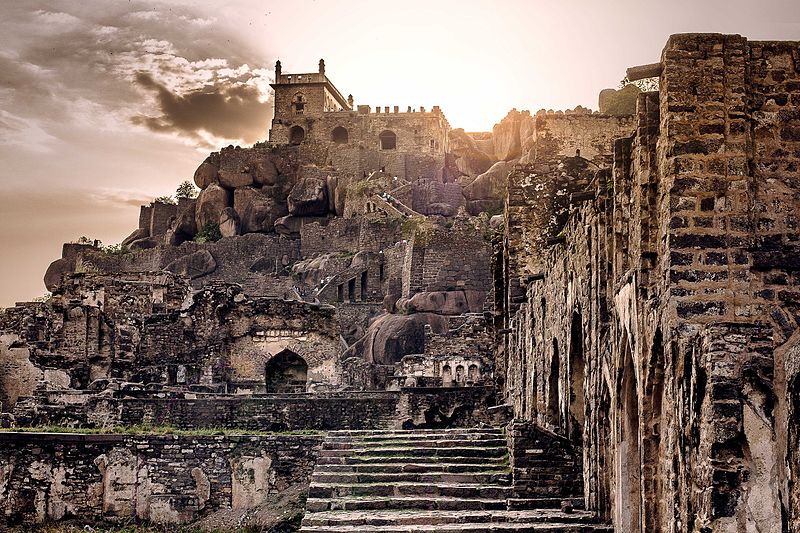
The Mughals tried to capture Golconda on two occasions. First in the year 1656, and then in the year 1687. Aurangzeb attacked Golconda for the first time during the reign of Sultan Abdullah Qutub Shah. At that time his prime minister was Mir Muhanmmad Sayeed Mir Jumla. He was a very able person and under him a large part of the Karnatak province was annexed to the Golconda kingdom. However due to certain circumstances, son of Mir Jumla was imprisoned by the Sultan. This led to a misunderstanding between them. Mir Jumla then appealed to Aurangzeb for release of his son. This gave him an opportunity to attack Golconda.
Sultan Abdullah had to release Mir Jumla's son and pay a heavy indemnity in offer for peace. He also gave his daughter in marriage to Aurangzeb's eldest son.
Sultan Abdullah Qutub Shah died in 1672. He was succeeded by his son-in-law Abul Hassan. During his rule Aurangzeb again attacked Golconda and was victorious in 1687. The siege had lasted for 8 months. Sultan Abul Hasan Tana Shah was taken prisoner and kept at Daulatabad Fort where he died in 1699.

Mughal amir on horseback,painting,17th century.
By Mughal School - bridgeman berlinfrom the Large Clive Albumhttp://www.art-prints-on-demand.com/a/mughal-school/a-mughal-amir-on-horsebac.html, Public Domain, https://commons.wikimedia.org/w/index.php?curid=16873985
Kilich Khan was an important commander in the Mughal army. His actual name was Hajji Nawab Khwaja Abid Khan Siddiqi Bayafandi. He was given the title Kilich Khan by Mughal Emperor Shah Jahan. He lost his life in the battle for Golconda. His son was Ghaziuudin Khan Firuz Jung. He was made Subahdar of Gujarat Subah during the reign of the Mughal Emperor Bahadur Shah I.
In 1690s, Ghaziuddin Khan had founded a madarsa, Madarsa Ghaziuddin Khan named after him. It became Delhi College which eventually paved way for the present Zakir Hussain College, under University of Delhi.In 1986, it shifted to a new building outside Turkman Gate; the old structure in the Madrasa Ghaziuddin complex still houses a hostel for the college and also has Ghaziuddin's mausoleum who had died in Ahmedabad in 1710. His son was the famous Mir Qamar-ud-din Khan Siddiqi, Asaf Jah I the first Nizam of Hyderabad who was born to Ghaziuddin Khan and Wazirunnisa Begum at Agra in 1671.The name Mir Qamaruddin Khan was given by Emperor Aurangagzeb.

Kilich Khan, Mughal,painting, 1900,Smithsonian collections.
By Mughal dynasty - http://www.asia.si.edu/collections/singleObject.cfm?ObjectNumber=S1986.441, Public Domain, https://commons.wikimedia.org/w/index.php? curid=18230169
When Mir Qamaruddin Khan was six the emperor gave him a mansab. He grew up to be a skilled warrior. He began to join his father in battle when he was still young. At 17 he joined in the assault at the Fort of Adoni. At 19, he was given the tilte Chin Fateh Khan by Aurangzeb.AT 20 was given the title of Chin Kilich Khan after the siege of Wagingera Fort. By 26 he was Commander-in-chief and Viceroy at Bijapur. He was later Viceroy at Malwa and finally of the Deccan.
After Emperor Aurangzeb died the Mughal empire began to lose its grip and was on the decline. Lot of confusion followed. Farukhshiyar who was Mughal emperor for some time gave him the title of Nizam-ul-mulk Fateh Jung. Later Emperor Muhammad Shah gave him the title Asaf Jah.

Emperor Farukhshiyar,painting,18th century.
By Attributed to Chitarman II (Kalyan Das) (active ca. 1700–45) - http://www.metmuseum.org/Collections/search-the-collections/60050361#fullscreen, Public Domain, https://commons.wikimedia.org/w/index.php?curid=18138484
When Qamaruddin Khan was the subahdar of Malwa he had stated asserting himself. After the death of Emperor Muhammad Shah, Farukhshiyar the sixth of Aurangzeb's successors called him to take on the Sayyid borthers but Farukhshiyar was killed in the strife. Mir Qamaruddin Khan was made vizier in the court of Muhammad Shah but got disgusted soon and resigned his post in 1724 and marched towards the Deccan, Mubariz Khan, the subahdar of Deccan, who had been appointed by Farukhshiyar, refused to vacate and opposed him; a battle followed at Shakarkhleda at Berar. Mubariz Khan was killed. The emperor gave him the title Asaf Jah, sent him jewels and an elephant. He was the Viceroy of the Deccan and the Mughal authority in the Deccan. In 1725 the Marathas demanded chauth (a tax) but the Nizam refused. A battle took place in 1727 near Nasik with Peshwa Bajirao. The Nizam also sent his troops to the aid of emperor Muhammad Shah to combat Nader Shah from Persia.The combined troops could not face the superior weapons and war tactics of the opposing forces. It is believed that the words of Asaf Jah I convinced him to stop his relentless massacre of Delhi.
Asaf Jah I ruled his territory well. In 1742 the British sent him him a hamper with goodies like
a gold throne,silver threaded silk from Europe,yards of velvet, brocades,Persian carpets,rose
water bottles, rose water etc. In return he sent a horse, a piece of jewellery and asked them not
to print their own currency. The British complied with the same. He died in 1748. Nizam-ul-mulk is well remebered
for laying the foundation of the Hyderabad State His descendants ruled as the Nizams of Hyderabad
of the Asaf Jahi dynasty till the Indian Independence.

Portrait, Nizam-ul-mulk,Mir Qamaruddin Khan,Asaf Jah I.
By Unknown - 1, Public Domain, https://commons.wikimedia.org/w/index.php?curid=1022094
- Hyderabad : a city in history/Khan, Raza Ali, Hyderabad : Zenith Services,1990.
- wikipedia.org
Posted by
Soma Ghosh
Ⓒ author