Delight in design : floral motifs in Bidri craft
Man is very much a part of nature and what he sees around him influences him deeply. This is more true for artists and craftsmen who are always inspired to create what they have visualised in their imagination. Flora and fauna abounds on this planet and have found their way into artworks. Vegetal and animal motifs are commonly seen in plastic arts, textiles and metalcrafts. We see surreal forms and stylised varieties of flowers, creepers, trees and animals. The designs create a magic of their own and hint at a greater reality beyond space and time.
Introduction : the beginnings of Bidri
The art of inlaying one metal on the other to make objects of art and utility is a very old one. It was used for making metal images of the Buddha with copper and silver inlay work in the 6th and 7th centuries, during the Gupta rule in India. The bronzes of Kashmir and Himachal Pradesh from 7th to 10th century and the Jaina bronzes of Eastern India, Central India and Deccan from 6th to 10th century had inlay work. The origin of Bidri craft is a bit of a mystery; the craft is believed to have been born in Persia. In Safavid Persia (750 -1258A.D) rulers and rich merchants used copper inlaid objects. Later gold ans silver was used and the art practised in many Central Islamic lands. The craft was brought to India by a nobleman. Khaja Moinuddin Chishti and his followers to Ajmer in Rajasthan. Much later a craftsman by name Abdullah-bin-Khaiser migrated to Bijapur in the Deccan and taught the craft to local artists. Bidar became a province of the Bahmani kingdom when it established its rule in South India. Sultan Alauddin II Bahamani (1434 -1457 A.D) of Bidar was gifted metal objects during his coronation and he was much impressed. He gave the craft the name Bidari or Bidri. He invited the craftsmen to settle at Bidar itself. They were provided with facilities and comforts so that they could carry on their craft. Thus with royal patronage the craft flourished under the Bahmanis and the later Baridis who ruled from Bidar. It travelled to other centres from 1770 A.D, of which Lucknow, Purnea and Murshidabad are noteworthy.

Bidar Fort view, Bidar, Karnataka.
By Tirumala Nalla - Own work, CC BY-SA 4.0, https://commons.wikimedia.org/w/index.php?curid=51144313
Techniques of Bidri making : creativity and skill set
The karigars or craftsmen used metals in a very imaginative way. The alloy was made out of copper, zinc and lead. The mixture of zinc and copper in of the ratio 16:1. Copper is added to make zinc take the polish better. On this silver or gold was used to make the design by inlaying in different ways. The techniques have Persian terms; tarkashi which means inlay of wire, taihnishan; inlay of sheet, zarnishan; low relief, zarbulund; high relief and aftabi; cut out designs in overlaid metal sheet. The beauty is created through contrast of the silver against a dark background. Silver is white , shiny after polish and malleable and ductile making it suitable for using during crafting. The process involved in the production of a Bidri item of art involves casting, polishing, engraving, inlaying and blackening the alloy. Designs are drawn with a fine point and pure silver is hammered into the pattern. The final polish is achieved with sand paper, charcoal and coconut oil. A way of blackening the Bidri object was by using a type of clay found at Bidar fort. A combination of techniques are used to make the final object. The craft is likened to Damascene work or koftgiri where gold or silver is encrusted on iron objects.
Designs on Bidri : vegetal and floral inspirations
The early Bidriware had beautiful Persian motifs. Designs of Middle Eastern origin and Egyptian floral designs were also incorporated. The ashrafi ki booti and teenpatti ki booti patterns are well known. Also kairi or mango, star patterns, vine creepers, poppy plant with flowers, mahi-pusht or fish scale pattern.
Bidar Fort garden, pool with fountain has an ornate pattern, Bidar, Karnataka.
By Santosh3397 - Own work, CC0, https://commons.wikimedia.org/w/index.php?curid=36533037
There are some awesome specimens of Bidriware now housed in different places across the world. The objects made include huqqa (hubble bubble) bases, afatabas or ewers, huqqa mouthpieces, mir-e-farsh or floor-weights, shamadan or candelabras, chilam or firecups,trays, goblets, pandan or betel boxes, ittardan or perfume boxes, gulabpash or rose water sprinklers, basins, plates and spittoons. More recently there is jewellery, ashtrays, walking sticks, paperweights and USB covers. The craft has gone through ups and downs but rulers across time have always encouraged and revived the craft. It thrives with exports, retailers and online sales. The workshops are now at Hyderabad and Bidar.
The skilled craftsmen have used Persian motifs on the alloy; local idioms like the lotus and swastika are found too. French influence is seen from the 18th century. Egyptian design also embellished the objects. Thus not only a combination of techniques but also design happened during the journey of the craft. However the main inspiration for designs on Bidriware are flowers and vegetal patterns like the creepers and leaves.
A beautiful poem by Ernestine Northover captures the essence of the flower in nature and its effects.
Oh, Flower
‘’Oh, flower, open wide your fragrant maze,
Curl back your petals, and greet the sun,
Look up and drink in its glorious rays,
Which will enhance your beauty, just begun.
Oh, flower, with colours of pure rich fire,
You will always radiate a warmth in me,
And your artistry ignites such desire,
That with truth you could be no parody.
Oh, flower, when raindrops touch your face,
And wild winds dictate your waving head,
Your stance will always sustain your grace,
And resplendence be found in your blossoms spread.’’
Woman with flowers, painting, Safavid Persia/Iran, 1575 AD, Freer Gallery of Art, Smithsonian, Washington D.C,U.S.A
By Unknown / Smithsonian Institution [Public domain], via Wikimedia Commons
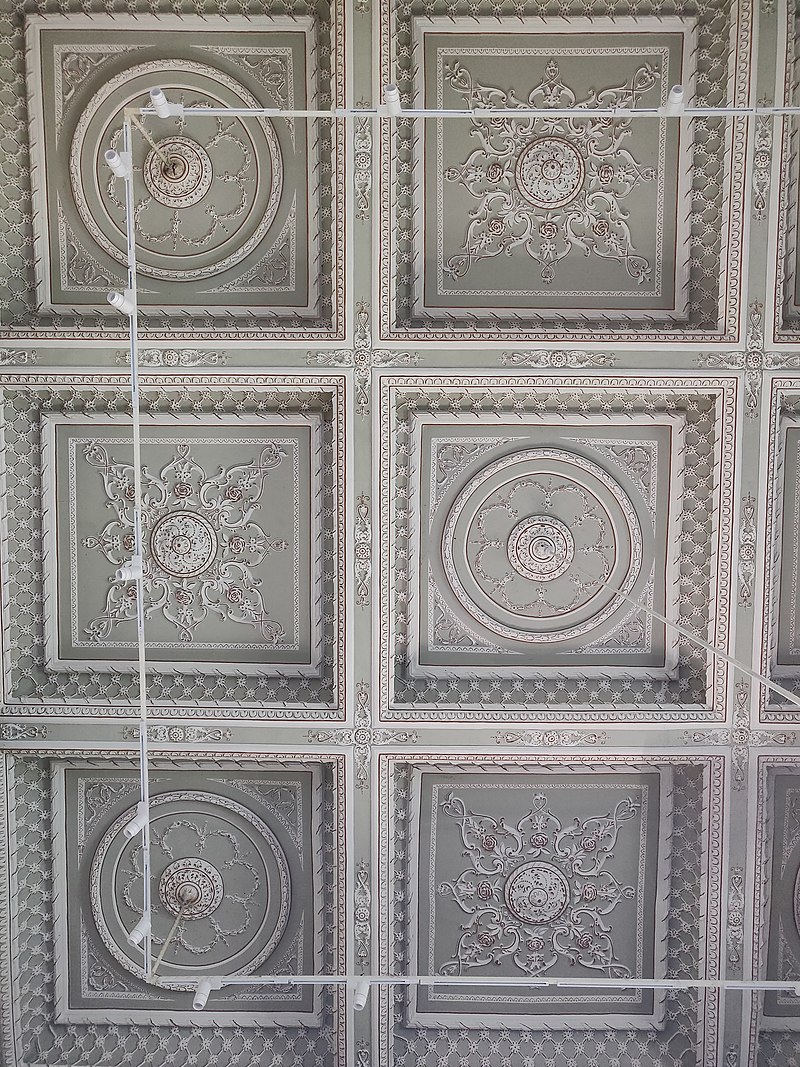
Ceiling design, Rangeen Mahal, 16th century, BIdar Fort, Bidar,Karnataka.
Source : https://www.flickr.com/photos/aloshbennett/4347383785
The images showcased highlight the different patterns and the briliant effect on the ware created painstakingly by the Bidri artist and craftsman. In many places a combination of motifs can be seen which enhance the final effect.
Vine creeper -A farsh-i-huqqa or huqqa base from 18th century depicts vine creepers in seamless design all over the body of the object to create a brilliant effect.
Huqqa base, tarkashi and tehnishan technique, Bidar, 18th century.
Los Angeles County Museum of Art [Public domain], via Wikimedia Commons
Grape vine, image.
By Lori (Flickr: That'll need to age a bit yet...) [CC BY-SA 2.0 (https://creativecommons.org/licenses/by-sa/2.0)], via Wikimedia Commons
Poppy plant and flower : the huqqa bases shown below depict a stylised poppy plant against a dark background. The poppy flower motif has been put to prolific use in Bidricraft.The poppy flowers signifies peace and tranquility.
Huqqa base, Bidar or Hyderabad, 18th century.
Los Angeles County Museum of Art [Public domain], via Wikimedia Commons
Poppy flowers,images.
In the image below the technique has been reversed. The dark base is made to stand out and the pattern is etched on the sliver sheet. The huqqa base has stylised poppy flowers with circular decorative scrolls towards the top and bottom.
Huqqa base, aftabi and taihnishan technique, Bidar or Hyderabad, 19th Century.
Los Angeles County Museum of Art [Public domain], via Wikimedia Commons
Huqqa base, gold work on alloy, Bidar, Mughal period,
Dallas Museum of Art, U. S. A,17th century.
By Daderot - Own work, Public Domain, https://commons.wikimedia.org/w/index.php?curid=68723894
Huqqa base, Bidar, Karnataka, late 17th century.
By Unknown - Marie-Lan Nguyen (2006), ಸಾರ್ವಜನಿಕರಿಗೆ ಸೇರಿದ್ದು, https://commons.wikimedia.org/w/index.php?curid=828340
Pandan or betel-box, tarkashi technique, stylised poppy and leaf patterns in circles on top, Bidar or Hyderabad,1800.
Los Angeles County Museum of Art [Public domain], via Wikimedia Commons
Cypress tree and flowers : the cypress motif is used in some huqqa bases. The flowers and the tree are depicted in stylised forms. The cypress is group of ceratin kind of trees or plants with similar characters. The plant is often mentioned in Persian poetry.The cypress is evergreen and designates hope, as the tree points to the heavens.
Huqqa base, Bidar, between circa 1600 and circa 1800.
By © Marie-Lan Nguyen / Wikimedia Commons, CC BY 2.5, https://commons.wikimedia.org/w/index.php?curid=20355115
Cypress tree.
By pellaea (Flickr) [CC BY 2.0 (https://creativecommons.org/licenses/by/2.0)], via Wikimedia Commons
Cypress flowers.

Cypress foliage, image.
Huqqa base, Bidar, Karnataka, 18th century.
http://www.columbia.edu/itc/mealac/pritchett/00glossarydata/terms/bidri/bidri.html
Lotuses in a pond : The sight of a lotus in a pond is one of nature’s most beautiful sights. The Bidri artists have captured this in their creations. A salver below depicts the lotus motif; blooming lotuses, lotus buds and lotuses floating on a pond. The border also made of lotuses enhances the beauty of the artwork as does the water body depicted as wavy lines. The lotus flower symbolizes beauty and spirituality.
Salver, Bidri ware, tarkashi and taihnishan technique, Bidar, 17th century.
Lotus flower, image.
Lotus flowers and buds in a pond, image.
Combination of star and flowers : The salver below depicts a starry concentric pattern with poppy design in the inner circle with alternating leaf motifs.
Salver, Bidri ware (tarkashi and tehnishan techniques),Bidar,17th century.
Los Angeles County Museum of Art [Public domain], via Wikimedia Commons
Concentric star pattten.
In the huqqa bottom depicted below the iris flower and plant have been used. The Iris flower is associated with royalty and signifies faith, wisdom and courage.
Huqqa with irises, late 17th century, MET Museum, USA.
By This file was donated to Wikimedia Commons by as part of a project by the Metropolitan Museum of Art. See the Image and Data Resources Open Access Policy, CC0, https://commons.wikimedia.org/w/index.php?curid=57856153
Iris flower,image
Plate, Bidar,17th century.
By Hiart - Own work, CC0, https://commons.wikimedia.org/w/index.php?curid=17606820

Aftaba or ewer, Bidriware, Met Museum, New York, 18th century.
By This file was donated to Wikimedia Commons by as part of a project by the Metropolitan Museum of Art. See the Image and Data Resources Open Access Policy, CC0, https://commons.wikimedia.org/w/index.php?curid=61138268
Ugaldan or spittoon, tarkashi and tehnishan techniques, Hyderabad, 1850.
Los Angeles County Museum of Art [Public domain], via Wikimedia Commons
Bidriware cup and lid, Bidar, Karantaka, 1850, V&A Museum, U.K
By VAwebteam at English Wikipedia - http://images.vam.ac.uk/indexplus/page/Home.html, GFDL, https://commons.wikimedia.org/w/index.php?curid=8500029
The earliest Bidriware of the 16th centuries are not available, mostly 17th century onwards one gets to study the various types. Over time the ware has changed according to the demands of the people. After the huqqa base, ugladans, sailabchis and aftabas one can see ashtrays, salvers and trays and now small decorative gift items, jewellery, vases and boxes of different sizes. The craft has seen many ups and downs during its journey but due to the constant efforts of its revival and support by the rulers right from the beginning it still lives ! Workshops are there at present in Bidar and Hyderabad.The magic of the objects created seem to be timeless. Only the forms on which the designs have been made have changed and adapted to changing times. Long live Bidri !
Bidriware, various floral motifs, 21st century.
By Shivapriya Sulgante [CC BY-SA 4.0 (https://creativecommons.org/licenses/by-sa/4.0)], from Wikimedia Commons
Bidriware, different stylised motifs, 21st century.
By Manjunath Doddamani Gajendragad at en.wikipedia - Source and Author : Manjunath Doddamani, Gajendragad / Hubli, Karnataka(North), India., Public Domain, https://commons.wikimedia.org/w/index.php?curid=17256729
Bidri craftsman, cypress leaf motif on USB drive, 21st century.
www.thehindu.com/news/national/karnataka/bidri-art-form-gets-modern-twist/article6292645.ece, August 2014
Kairi shaped Bidri dibba, 21st century.
Source : Jaypore.com.
Mango, image.
References :
Narayan Sen, Catalogue on Damascene and Bidri Art, Indian Museum Calcutta, 1983.
Krishna Lal, Catalogue, National Museum Collection Bidri Ware, National Museum of India, New Delhi, 1990.
Jagdish Mittal, Bidriware and Damascene work in Jagdish and Kamla Mittal Museum of Indian Art, JKMMIA, Hyderabad, 2011.
http://granthaalayah.com/Articles/Vol4Iss3/19_IJRG16_B03_27.pdf
Wikipedia.org
Census of India 1961 :Vol II - Andhra Pradesh, Delhi : Manager of Publications,1967.
Sultans of Deccan India/Navina Najaf Hyder and Marika Sardar, New York : Met Museum, 2015.
Posted by :
Soma Ghosh
Ⓒauthor

 Posts
Posts