Showing posts with label textiles. Show all posts

Thursday, 27 December 2018

Tree of life : images from Golconda textiles

Tree of life : images from Golconda textiles


      The art of Kalamkari  originated in Machilipatnam, Pallakolu and other places along the Coromandel coast during the 17th century.  It originated as a religious tapestry and later became a secular craft under Muslim rule. The kingdom of Golconda in the Deccan, India was a trading centre for diamonds, gems and textiles. The word Kalamkari or working with the pen evolved when the Golconda Sultans called the craftsmen as ‘kalamkars‘. ‘Kalamkari‘ thus literally means, art work done using a pen. The craft continues to this day with many families devoted to this art. Natural substances from plants, trees and seeds are used in the art and called painted using resist and mordant technique. Depicted are some images using this technique, of the tree of life, a unique and universal concept.
        
   The tree of life is a concept mainly from mythology, a sacred belief connecting all forms of creation. it is depicted in various cultures and traditions of the world. The tree of life is thought of as related to the eternal, a destroyer of sorrow, health, fertility, wisdom and calmness. In the Hindu faith it is the wish fulfilling Kalpavriksha which grants every wish. In Christianity the tree is the source of eternal life. The tree of life is the tree of immortality in Islamic faith. The concept spans across cultures. It is asymbol of connectivity, having roots with the soil; the leaves and branches reaching to the sky, receiving the sun and air. The tree of life represents continuity as it grows from a seed and creates a fruit with seeds, which again gives birth to the new. The tree of life is a symbol of rebirth, the leaves fall in autumn or hibernate in winter and in spring the new leaves appear like being born again. 

Image result for golconda designs


Tree of life,  Tent Hanging or Curtain, late 17th century, Golconda, LACMA, U. S. A.
 
    Charles Darwin proposed a tree of life which is symbolic of the source of all living things. In Chinese mythology,a dragon and phoenix are depicted in the tree of life. The dragon represents immortality. The Bodhi tree is the wisdom tree under which Siddharta Gautama attained enlightenment and became the Buddha. This tree is seen as one where once can seek refuge from worldly desires. the Celtic tree symbolises the forces of nature joining together to maintain balance in the universe. Many animals are are also seen in the tree of life depictions. Birds too are seen on the branches. sometimes the underworld is shown with a water-monster. All forms of life are connected and humans should live in harmony with the world. Everyone has a right to exist and grow as we are children of the Universe.


                The block-printed and dyed textile from the Coromandel coast depicted below consists of a tree of life within ovoid medallions, flanked by cobras and peacocks, the border is of a continuous floral garland. Originally this technique of painted resist and mordant happened under the rule of the Golconda kingdom (1512-1687). However the practice continued in the following centuries with ups and downs, but continues to this day though the designs have changed over the years. The technique was called Kalamkari which is still prevalent.

A PALAMPORE COROMANDEL COAST, SOUTH INDIA, SECOND QUARTER 19TH CENTURY The block-printed and dyed decoration consisting of a central tree within ovoid medallions, flanked by cobras and peacocks, the border a continuous floral garland, small inventory or shipping stamp to a corner 116 ½ x 91in. (296 x 231cm.

Palampore, painted resist and mordant, dyed textile, Coromandel coast, 19th century.

Image sourced from Christie's.com


Palampores were a regular feature of the 18th-century chintz trade to Europe, where they were used as wall hangings and bed-covers and table-cloths. The embroidered palampore below was chain stitched in silk on cotton to create a painted effect. The craftsmen have worked out white silk stitches within the flowers to simulate the tiny white  patterns that appear on painted textiles. Instead of shown as emerging from the usual hilly mound, this tree grows out of an interpretation of a Chinese scholar’s rock, highlighting the overlapping of Chinese, Indian, and European motifs in 18th-century exotic textiles from the East.

* Palampore Cotton embroidered with silk mid-18th century (Coromandel Coast), for the European market Embroidered Palampore was chain stitched in silk on cotton to imitate a painted palampore with remarkable precision. The embroiderers even used white silk stitches within the flowers to simulate the tiny white reserve patterns that appear on painted examples.

Palampore, embroidered textile, cotton with silk, Coromandel coast, mid-18th century, Met Museum, U S A


Palmapores depicting the tree of life show a central flower-and-fruit-bearing serpentine tree emerging from a hillock with stylized peaks or rocks. In addition to those produced for the Dutch and English markets, a class of smaller palampores was made expressly for the intra-Asian trade. This painted version depicted below was originally sourced to Sri Lanka, maybe produced for the European communities in Batavia and Colombo.

Palampore, Cotton (painted resist and mordant, dyed), India (Coromandel Coast), for the Sri Lankan market

Palampore, painted resist and mordant, dyed textile, Coromandel coast, early 18th century, Met Museum, U S A.


 The textile piece below is a tree of life depicting the mound, peacocks and flowering tree. The border is an ornate double floral scroll. Done using the Kalamkari technique it is an exquisite work.
Olive-Multicolor Cotton Hand Painted Kalamkari Wall Hanging 46in x 32.5in
Tree of life, Kalamkari hanging, 21st century. 

Image : Jaypore.com


References :


  • wikipedia.org
  • wootandhammy.com
  • spiritualray.com
  • old-earth.com


Posted by:

Soma Ghosh

Ⓒauthor


Wednesday, 12 April 2017

Golconda paintings: the pichhvai tradition

Golconda paintings : the pichhvai tradition


    The kingdom of Golconda has produced many pichhvai paintings. Originally this art is popular among the Vallabhaite sect in Narthdwara, Rajasthan. Since merchants and traders of this sect came from Rajasthan and Gujarat to the kingdom of Golconda, they brought their art with them. A pichhvai is a decorative hanging in cloth behind the main deity , a form of Krishna; Srinathji, inside the temples.Lord Krishna is a much loved deity among the Hindus in India.He is also an important character in the epic Mahabharata.
  
   The Nathdwara pichhvais depicted Lord Krishna as Srinathji. However the ones produced at Golconda, the depiction is of the Deccan-Maratha style. Though the local artist copied the Rajasthani tradition the Deccan stamp is present.The gopis or cowherd maidens are also slightly different by being more slender and taller. The cows depicted have longer bodies to match the gopis. The gopis are seen in typical Deccan way of dress and jewellery, the foliage is lush,umbrella type with straight tree trunks. The tree is most likely the kadamba tree, associated with Lord Krishna. 

        The pichhvai depicted below is dyed cotton with polychrome and  gold work. It represntative of the Dana-lila in which the gopis have to give a dana or toll to Lord Krishna . It could range from an embrace to a pot of milk ! The gopis are however feigning resistance to Krishna and are look surprised in the scene.The scene is almost mystical with a dream like quality. Peacocks are depicted along with parrots and some other coloured birds. There also is shown the silent showering of fragrant flowers like the chameli and champa from the sky on Krishna and the gopis. On the right below is seen Krishna nad Radha along with the cows who seem to be looking up to them, very much a part of the scene. The cut portion is actually meant for the space where the deity would be placed for worship.


File:'Playful Gifts and other Gopi Scenes', 'pichwai' from Golconda, India, , late 17th century, dyed cotton with polychrome and gold, Honolulu Academy of Arts.jpg

Pichhvai from Golconda, late 17th century, Honolulu Museum of Art,USA.


See page for author [Public domain], via Wikimedia Commons


References :
  1. Art and architecture of Qutub Shahi times/Meena Kumari, V./Delhi : B. R Publishing Corporation,2014.
  2. Golconda and Hyderabad/Safrani,Shehbaz.H,ed.Bombay : Marg Publications,1992.


Posted by :

Soma Ghosh

Ⓒauthor


Saturday, 18 March 2017

Chintz of Golconda : paintings on cloth

Chintz of Golconda : paintings on cloth


        The kingdom of Golconda was a trading centre for diamonds,gems and textiles. They patronised Kalamkari of Machilipatnam, a hand-painted craft during the 16th and 17th centuries. The textiles were made for the Sultanate of Golconda and Iran/Persia.  The designs were customised to the Islamic taste. The art of Kalamkari had evolved wherein the artist works with a pen or qalam; this art flourished in Srikalahasti too where temple hangings were made and in Machilipatnam in South India, as already mentioned. The English called it chintz, the Dutch called sitz,  the Portugese pintado. with time all cloth with patterns came to be known as  chintz. The Srikalahasti kalamkaris had an almost religious identity; scenes from the Hindu epics like Ramayana, Mahabharata  were made for scrolls,chariot banners etc.These were completely hand-worked.

      The kalamkari techinique used the qalam to trace patterns on the cloth. Vegetable and natural dyes extracted from parts of plants like roots,leaves and mineral salts of iron,tin, copper etc. were then filled to create the final product.  The artist was called qalamkar. Kalamkari thus literally means, art work done using a pen. In Machilipatnam hand-carved block prints were used. Finer details were made with qalam.

    The Machilipatnam artists made prayer mats, wall hangings,curtains,cloth belts etc. The designs included the cypress tree,mihrab (prayer niche) of a mosque and animals mentioned in Islamic writings. Floral patterns were much in use for many creations made for both the Europeans,for Persia and the Golconda kingdom. The tree of life is also a common theme. Human figures were also depicted.

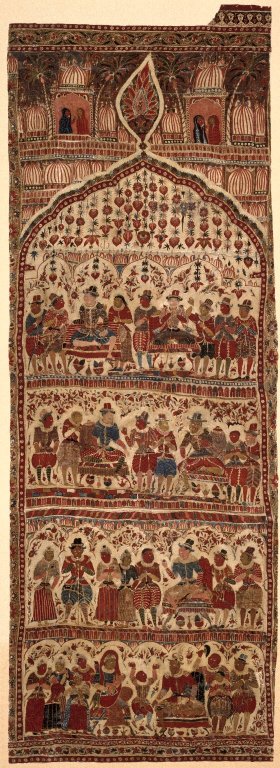
   The wall hanging depicted below has five panels within a floral pattern framework. Floral designs can be seen within the panels too. The scenes depict Europeans and locals.
There are two mandapas on top with two women in each. There are onion shaped domes above the arch; the wall hanging depicts multi-cultural character.


Kalamkari wall hanging, early 17th century.

By Online Collection of Brooklyn Museum; Photo: Brooklyn Museum, 14.719.2_SL1.jpg, Public Domain, https://commons.wikimedia.org/w/index.php?curid=10195568

     The creation below is a qanat or a curtain for a tent, with exquisite floral design. The main design, a flowering plant,  is in the middle with smaller flowers used in the multi-layered frame around it.

Curtain for a palace or royal tent from South India, Doris Duke Foundation for Islamic Art.JPG

Curtain for a royal tent (qanat) from Andhra Pradesh or Tamil Nadu region, 1665.

By Hiart - Own work, CC0, https://commons.wikimedia.org/w/index.php?curid=53643424


References :


  1. wikipedia.org
  2. The heritage of the Qutb Shahis of Golconda and Hyderabad/Nayeem,M.A,Hyderabad : Hyderabad Publishers,2006.


Posted by :


Soma Ghosh


©author