Showing posts with label Mahboob Ali Khan. Show all posts

Friday, 28 February 2020

Saidanima's tomb - a beautiful memorial for his mother

Saidanima's tomb - a beautiful memorial for a mother

           Nawab Diler ul mulk built a beautiful memorial for his mother Saidanima. He was a noble during the rule of Nawab Mir Mehboob Ali Khan, Nizam VI of Hyderabad. Saidani Ma Tomb or Saidani Maa Tomb, is a tomb located in Hyderabad near Hussain SagarThe tomb in Mughal and Qutb Shahi styles with elaborate stucco decorations and fretwork screens (jalis) was built by Nawab Syed Abdul Haq Diler Jung for his mother Hazrath Saidani Ma Saheba in 1883, during the reign of Asaf Jah VI. Syed Abdul Haq, was conferred with the title Diler-ul-Mulk by the Nizam VI for his administrative capabilities. He was the son of a hereditary chieftain in the Deccan: joined the Bombay Government service before he was 20 but later joined the Hyderabad service.Sir Salar Jung I sent him to England to obtain an alteration in the guarantee which the Nizam VI had given on his State railway and for effecting this, he was rewarded and given a mining monopoly in the Nizam's state, from which he made a personal profit of nearly a quarter of a million: but, after the publication of the facts in 1888, he suffered some political downfall but tried in vain to regain his position in the Nizam's service, he died in May, 1896. However the tomb that he made for his mother is an amazing structure and he too lies buried in the same site, near his mother.

Image result for saidanima tomb secunderabad

Saidanima's tomb, image, photo by Raja Deen Dayal,1880s.


The structure is constructed on a raised square platform an intricately engraved dome, flanked by well designed minarets. The facade has five arches;the parapet wall has two tier style. There are floral designs on the structure and small niches  in the parapet wall. Conch shaped ''kalasha'' motifs are seen on the tomb.The ground floor and first floor display beautiful combination of Qutubshahi, Asafjahi and European elements. The tomb-monument is very fine with intricacy of patterns with dainty decorated elements.


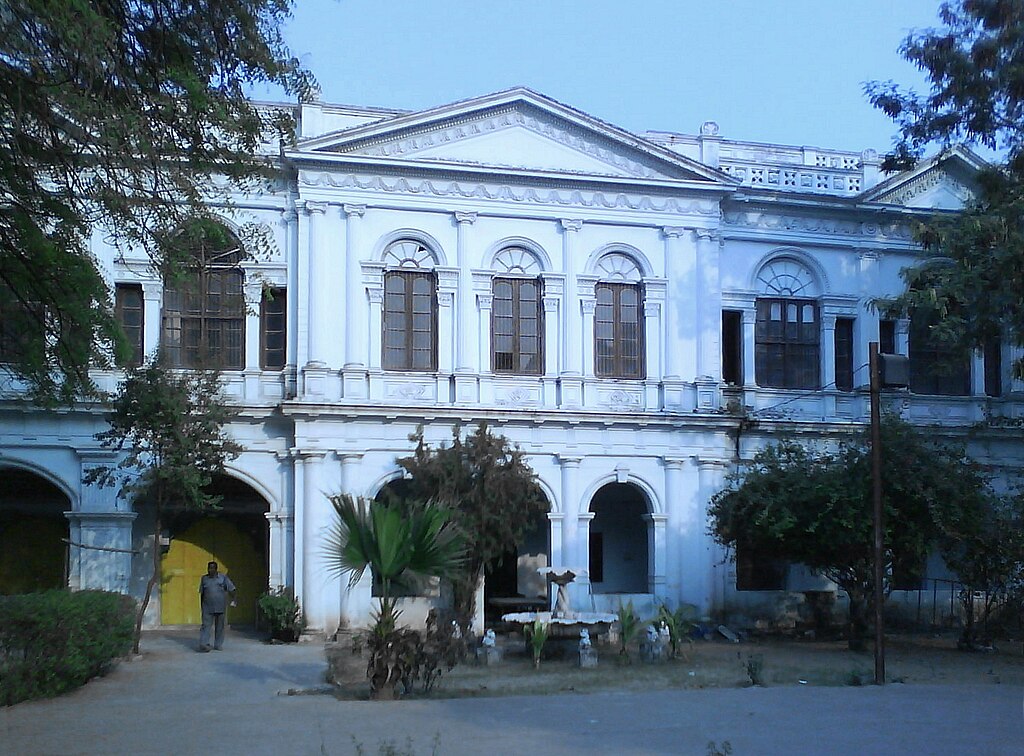
Saidanima's tomb, image,21st century.


References and image attributions


  • Wikipedia.org
  • wikisource.org
  • telanganamuseums.in
  • Images are from Wikimedia Commons


Posted by


Soma Ghosh

Ⓒauthor

Thursday, 14 June 2018

Purani Haveli : grand mansion of Nizam

Purani Haveli : grand mansion of Nizam


      The erstwhile rulers of Hyderabad-Deccan, the Nizams built many palaces. One of them is a majestic one; the Purani Haveli, which means Old mansion. Done mostly using 18th century European style of architecture, believed to be inspired by Palace of Versailles in France, the haveli is in the form of a complex and has eleven buildings. The area was originally earmarked by Mohammad Quli Qutub Shah, fifth Sultan of Golconda who established Hyderabad city; for his peshwa , Mir Momin but those Qutub Shahi structures don't exist now.

   Nizam Ali Khan, Asaf Jah II (Nizam IInd) got the place from Nawab Ruknudowlah for his son Sikandar Jah. In 1777 he started construction of new buildings. When Sikandar Jah shifted to Khilwat Mahal the palace complex came to be called ''old'' or Purani. The buildings consist of Masarath Mahal,Rahat Mahal,Mader-a-Deccan Mahal, Zenana Mahal, six ancillary palaces and two double storied buildings. This haveli was once the official residence of the Nizam, the residence being located in the middle. Nawab Mir Mahboob Ali Khan, Nizam VI (1866-1911) occupied the Masarath Mahal which was built in European style. The palace has an entrance portico with Corinthian columns in the front and entrances on the three other sides. 


Asaf Jah VI.jpg


Nawab Mir Mahboob Ali Khan, Nizam VI, image.

The photograph was first published in the Illustrated London News in 1889.

Source : Wikimedia Commons

        The Mahal had the world's longest wardrobe at two levels connected by a unique-hand operated wooden elevator. One whole wing of the U-shaped palace complex was devoted for this wardrobe. The Hindu newspaper notes : ....''Mahboob Ali had a huge wardrobe in his palace that ran for more than hundred feet in length, considered to be the longest in the world. As his wardrobe was on the first floor of the palace, a lift was fitted for the Nizam to access his wardrobe every day with ease.'It is interesting to note that this hand-operated wooden lift at the Purani Haveli palace, in its shining best is still in perfect working condition.'' 


Largest wardrobe of Nizam VI, Purani Haveli, Hyderabad.


Pic source : The Hindu, 25th May,2017, Photo credit : Mohammed Yousuf.

Many renovations were made during the 19th and 20th centuries using mostly European style. The ancillary palaces were constructed by Nawab Mir Osman Ali Khan, Nizam VII on either side of the Masarath Mahal. They have similar plans having square open space in the middle with a fountain adorning it. These palaces have alternating entrance doors in which one is only the real door and the other is a copy which does not open but looks real ! The Zenana Mahal, Rahat Mahal and Madar-e-Deccan palace are behind the eastern wing of the double storied structure. At Madar-e-Deccan, mother of Nizam VII used to reside whom he used to visit regularly. The Rahat Mahal is opposite to this with a garden and fountain in between. This palace has coloured frescoes of flowers and birds in triangles over the doors of its main hall which has smaller halls on its sides.  The Zenana Mahal is within a rectangular wall and is made up of six buildings having semi-circular design.   

       The haveli now houses the Nizam Museum set up in 2000 A.D in the western wing of the u-shaped double-storied building. ''....the exhibits at the museum include a golden throne, a miniature replica of the jubilee hall, a glass inlay painting of Nawab Osman Ali Khan in which the (VIIth) Nizam appears to move so as to face the visitor from all sides. other exhibits include a wooden writing box studded with mother-of-pearl, diamond and gold-studded daggers, caskets, and silver ittardans (perfume containers) presented by the Raja of Palvancha. a 125-year-old manually operated wooden elevator (capacity 6-8) used by the sixth Nizam, Nawab Mir Mahboob Ali Khan, is at the museum. "the Nizam tried to blend all cultures, regardless of religion. the culture of his time was known as the `ganga-jamuni tehzeeb'," as per Sri Bhaskar Rao. The elevator was designed by R. Waygood Co., London. The wardrobe is designed with teak from Burma and is 120 feet long on each side. Nizam VI was a style icon of his time, very fond of dressing and never used to repeat his clothes, which were mostly given away. The wardrobe is mostly empty with a few clothes from the time and footwear at the second level probably used by the Nizams. 


The Nizam Museum reflects the times of the Nizams of Hyderabad through different exhibits displayed. There are silver models of important buildings including the Moazzam Jahi market, the Osmania University and a golden replica of the Jubilee pavillion of Nizam VII.The museum houses many artefacts pertaining to the time of the erstwhile rulers, also priceless gifts and momentos received. There is an amazing ornate gold tiffin-box in the collection !


     There is also a City Museum at Purani Haveli established in 2012, planned and curated by Anuradha Naik, noted Conservation Architect in Hyderabad, which tells the story of the area from the 13th century through text, images and artefacts in an interesting way. There are old maps of the area. Information about the architecture, armoury, textiles,railways, aviation, languages, weights and measures, all find representation in the City Museum. The City Museum  also displays clay pots found during an excavation at the University of Hyderabad, Gachibowli which are around 4000 years old.The Purani Haveli complex area  has a hospital and  educational institutions now. 
Nizam museum.jpg

Purani Haveli, Hyderabad.

By Randhirreddy - en.wikipedia.org, Public Domain, https://commons.wikimedia.org/w/index.php?curid=12073341


Related image
Purani Haveli, Hyderabad.


  By Randhir - Own work (Original text: I created this work entirely by myself.), Public       Domain, https://commons.wikimedia.org/w/index.php?curid=34985683


Cannon, Purani Haveli complex, Hyderabad.

                                         Image courtesy : Syed Ahmed Khan


                          Part of Zenana Mahal, Purani Haveli complex, Hyderabad.
                           
                                         Image courtesy : Syed Ahmed Khan


                                   Wooden cabinet, Purani Haveli, Hyderabad.                                                              
                            Pic Source : as appeared in The Hindu, Jan 21,2004. 


References :


1. Palaces of the Nizams/Nayeem, M. A, Hyderabad :Hyderabad Publisher,2009.
2.  wikipedia.org
3. http://www.thehindu.com/lf/2004/01/21/stories/2004012111120200.htm
4. https://timesofindia.indiatimes.com/city/hyderabad/Nizams-Museum
5. http://www.thehindu.com/society/history-and-culture/Mahboob-Ali-Pasha-Legend-with-a-lavish-lifestyle
6.http://www.thehindu.com/life-and-style/heh-nizams-museum-and-city-museum-at-purani-haveli-offer-a-window-into-the-times-of-hyderabad-during-the-reign-of-sixth-and-seventh-nizams 
7. https://www.theweek.in/theweek/leisure/the-nizams-museum


Posted by :


Soma Ghosh


Ⓒauthor


Saturday, 24 June 2017

Nizam VI : Mir Mahboob Ali Khan

Nizam VI : Mir Mahboob Ali Khan,people's beloved


        Born in 1866 at Purani Haveli,Hyderabad, Mir Mahboob Ali Khan was the 6th Nizam of Hyderabad State. He ruled between 1869 to 1911. Hw was the son of Afzal-ud-dowlah, Nizam V. His father died when he was only 2 years and seven months old. He was installed on the throne but with two regents Mir Turab Ali Khan, Salar Jung I and Nawab Rasheeduddin Khan. However Nawab Rasheeduddin Khan died in December 1881 and Salar Jung I became the sole regent.

File:The Young Nizam Mehboob Ali Khan of Hyderabad, With Attendants, 1870s.jpg

Young Mahboob Ali Khan with others,photograph,1870s.

By Nawab Mohammed Azeezuddin Khan (son of Nawab Lateefudin Khan) (Scan of the original photograph) [Public domain or Public domain], via Wikimedia Commons


   Under the guidance of Salar Jung I, Capt. John Clark was appointed to tutor him. Teachers of Persian,Arabic and Urdu also tutored him. He grew up to be a respected leader and was called Mahboob Ali Pasha.  His doctor was Dr.Abdul Hussain who was later called Arastu Yar Jung. Nizam VI was a ruler believed to have mystic powers who could cure snake bites. He knew Urdu,Persian and Telugu and composed poetry. 

   Mahboob Ali Pasha led a flamboyant lifestyle and had lots of clothes and cars. He owned sherwanis, coats,shirts footwear,walking-sticks and perfumes. He purchased a diamond which became famous as the Jacob diamond. He was very helpful to the people during the floods of 1908 at Hyderabad and opened the palace gates for the affected. He died in August 1911.

    During his lifetime he had acquired many titles : as a young prince he was Sahibzada Mir Mahboob Ali Khan Siddiqui Bahadur. He was llater on Rustam-i-dauran,Asaf Jah Vi,Nizam-ul-mulk,Sipah-salar, Lieutenant General,Fateh Jung GCSI,GCB,Nizam of Hyderabad among others.


File:Asaf Jah VI.jpg


Nizam VI, Mir Mahboob Ali Khan.


See page for author [Public domain], via Wikimedia Commons
Published in 1889.(Illustrated London News)


Image result for Nizam VI 

Coat of arms, 1893.


By Sir Roper Lethbridge (Golden Book of India, 1893) [Public domain], via Wikimedia Commons


File:Franz Ferdinand by Dayal, 1893.jpg


Archduke Franz Ferdinand with Nizam VI during visit, January 1893, Hyderabad.


By Lala Deen Dayal, State Photographer (Dorotheum) [Public domain], via Wikimedia Commons


References :

  • Hyderabad : a city  in history/Khan, Raza Ali, Hyderabad : Zenith Services,1990.
  • wikipedia.org

Posted by

Soma Ghosh


Ⓒ author