Saturday, 26 November 2016

Taramati and Premamati : royal dancers at the Qutub Shahi court

Taramati and Premamati : royal dancers at the Qutub Shahi court


       Two beautiful dancers were courtesans at the VIIth Qutub Shahi Sultan Abdullah Qutub Shah's court (1626-1672) and during Abul Hasan Tana Shah (1672-1686), the last Qutub Shahi Sultan's reign : Taramati and Premamati. They had beautiful voices and enthralled the kings with their singing and dancing.They had pavillions built for them. Taramati Baradari is two storeyed , square shaped with strong arches on all sides, a typical Qutub Shahi structure with fine acoustics; and is located  some distance away from the Golconda Fort on a hillock. It is believed that when Taramati sang the breeze used to carry her mellifluous voice to the Sultan who was two kilometres away. The sisters have also been said to have danced on moonlit nights on ropes connecting the Baradari to the Golconda fort. Taramati was a dancer and singer par excellence and devoted her entire life to her art. She used to entertain people at the Taramati Baradari. A legend says that Taramati continued dancing even when Emperor Aurangzeb had asked her to stop.


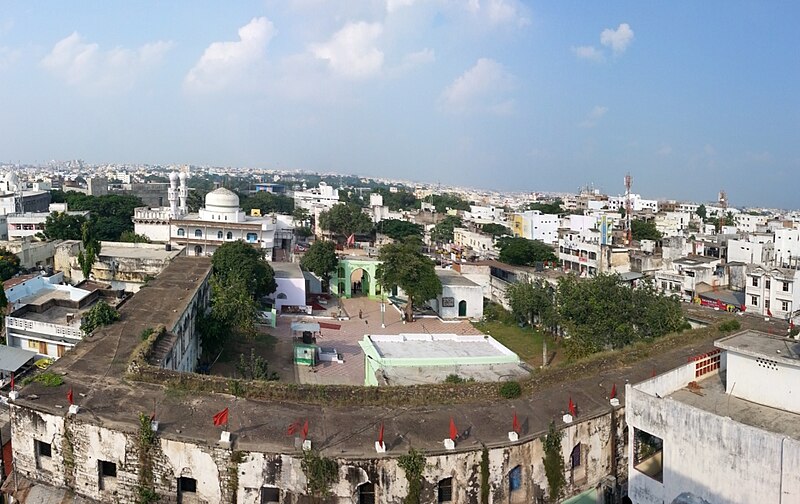
On the opposite side is the Premamati mosque, which is believed to have been used by them for offering prayers. Both the sisters are buried in the royal cemetery of the Qutub Shahis at Ibrahimbagh in Hyderabad.


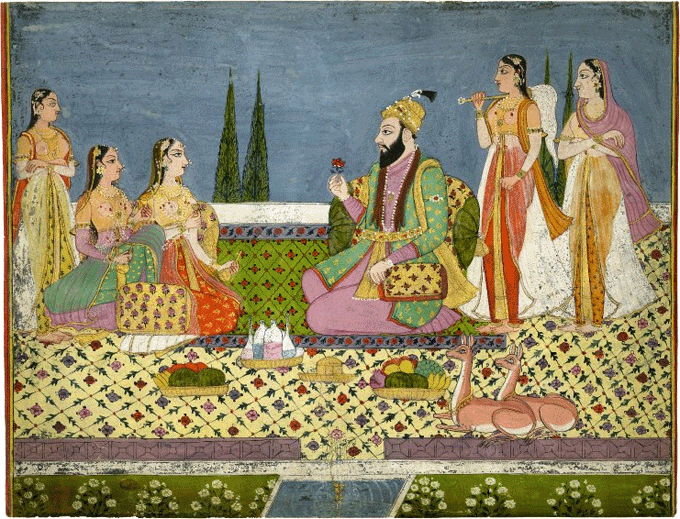
Abdullah Qutb Sháh on a Terrace with Attendants.jpg
Sultan Abdullah Qutub Shah with attendants, painting, Deccan School, 18th century.

By Deccan School - http://www.harekrsna.com/sun/features/12-11/features2319.htm, Public Domain, https://commons.wikimedia.org/w/index.php?curid=21077967


 Taramati (probably), artist's representation (image at the Baradari complex,2016)

Pic : Isha Vatsa         


Premamati (probably),
artist's representation (image at the Baradari complex,2016)

Pic : Isha Vatsa             

Taramati Baradari.jpg

Taramati Baradari near Golconda, Hyderabad

By Chiranjeevi Ranga - I took the snap.., CC0, https://commons.wikimedia.org/w/index.php?curid=15997210

File:Night View of the Great Golconda Fort.jpg

Night view at Golconda Fort.


By Devsneha (Own work) [CC BY-SA 4.0 (http://creativecommons.org/licenses/by-sa/4.0)], via Wikimedia Commons


Taramati mosque inside the Golconda Fort complex.

By Bernard Gagnon - Own work, CC BY-SA 3.0, https://commons.wikimedia.org/w/index.php?curid=34267456


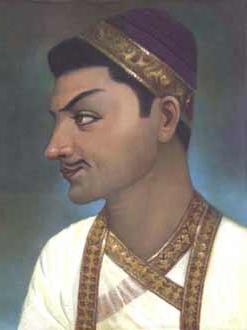
Abul Hasan Qutb Shah.jpg


 Abul Hasan Tana Shah, the last Qutub Shahi sultan.

Public Domain, https://commons.wikimedia.org/w/index.php?curid=244237


Tombs of Taramati and Premamati.

Pic source : Isha Vatsa


References :


  • Khan, Raza Ali/Hyderabad 400 years (1591-1991), Hyderabad : Zenith Publishers,1990.
  • wikipedia.org


Posted by  :


Soma Ghosh

© author


Friday, 25 November 2016

Bhagmati : the Sultan's beloved


        Did Bhagmati really exist or she is a figment of a romantic imagination ?  Most people would like to believe that she did. Historians will agree and disagree and the debate will continue for ever. However there has been found enough evidence including a tomb in the old city of Hyderabad which is supposedly hers, to indicate her existence during the time of the founder of Hyderabad, Sultan Mohammad Quli  of the Qutub Shahi dynasty of Deccan history of India. She was an important presence after whom not only poetry was composed, but a new city was named, Bhagnagar. It was later changed to Hyderabad after her marriage to the Sultan(after she embraced Islam)and her name was changed to Hyder Mahal.


          It all started on a fateful day  in late 16th century, when a beautiful village belle who was also a dancer, was going to a temple in Chichlam (an area close to the Charminar built later). The sound of horse-hooves startled the young girl who stopped in the middle of her tracks, on way to a temple nearby. The person on the horse looked sharp at her. His friends seem to vanish a little into the background. Who could this be, she wondered. He seemed royal and in the prime of his youth with a very handsome face. He could not take his eyes of her and seemed smitten by her beauty. She went in to the temple and came out after her prayer. He began to converse with her. She too spoke back and a tender friendship  took birth.  More meetings followed and continued for 11 years. 
   
      She became his favourite and once when the river Musi was flooded he came searching for her fearing for her life, crossing it in full fury. Seeing his passion his father the Sultan of Golconda, constructed a bridge, the Purana Pul, as it is known now, so that he would not have to risk his life again to meet his beloved. Mohammad Quli became the king after his father Sultan Ibrahim Qutub Shah died in 1580. This bridge also served to connect the old city with the newer extension of Hyderabad city across the Musi in order to help spread out the over populated fort-city of Golconda.

Image result for purana pul

Purana pul,photograph,Hyderabad,1892.

Lala Deen Dayal [Public domain], via Wikimedia Commons
  

Image result for muhammad quli

Artist representation of the meeting between Bhagmati and Mohammad Quli.

Source : http://www.deccanchronicle.com/nation/current-affairs/110916

    Bhagmati was given special honours by the new king. Every time she came to visit him, 1000 horses would accompany her Though there was strong opposition as Bhagmati was a Hindu woman, Mohammad Quli married her. After converting to Islam she bcame Hyder Mahal. His Peshwa Mir Momin had an important role in the same. 


File:Wedding procession of Muhammad Quli Qutub Shah.jpg

Sultan Mohammad Quli bringing his bride Bhagmati, painting.

https://upload.wikimedia.org/wikipedia/commons/1/1f/Wedding_procession_of_Muhammad_Quli_Qutub_Shah.jpg See page for author [Public domain], via Wikimedia Commons


Bhagmati in a miniature painting, Deccan school.

Source : Nathan Hughes Hamilton on Flickr via Creative Commons from his album 'Samples of Indian Art'.

Bhagmati has been mentioned directly or indirectly in many historical accounts. Ferishta mentions that the Sulltan was fascinated by her. He mentions Bhagnagar whose name was later changed to Hyderabad. Faizi, Emperor Akbar's resident in Ahmadnagar a kingdom in the Deccan, mentions Bhagnagar as being built after Bhagmati. Tavernier (1648 and 1652) Thevenot(1665-66), Bernier(1667) all refer to Bhagnagar in their travel accounts. Bhagnagar is referred to in Tareekh-e-Qutub Shah by Qader Khan Munshi (1888) and Gulzar-e-Asafi (1844).


References :

  • wikipedia.org
  • Luther, Narendra/Prince, poet, lover, builder : the founder of Hyderabad, New Delhi : Publications Division, 1991.
  • Rao, Bhoopala K.V/ The Qutub Shahi Prime Ministers. Hyderabad : Mahamantri Madanna Trust, 1992.

Posted by  :


Soma Ghosh


© author


Mir Momin Astarabadi: architect of Hyderabad


Mir Momin Astarabadi: architect of Hyderabad 


      Going back in time to the 14th century, the Deccan plateau in Southern India was being governed by the Bahmani Sultanate which had been founded in 1347. People from different parts of the world  were coming here and getting settled in the region after securing good appointments at the Bahmani court.

     Mir Momin Astarabadi was one such migrant who was from Astarabad in Persia (Iran). He was from a family of scholars and his family had instilled him with qualities like discipline and civility. He worked as a tutor to the imperial crown prince, Hyder Mirza but  as the prince died unexpectedly followed by his father Tahmasp Safavi; he left Persia and went to Mecca. Finally he came to Golconda in 1580 when Sultan Mohammad Quli was its ruler. 

     Mir Momin was teaching theology and lecturing in mosques and soon became well known in Golconda. He was of the Shia faith and was soon spotted by the Sultan who appointed him as his Peshwa in 1585. 


 Mir Momin Astarabadi (1585- 1624/5 A. D.)

    Peshwa Mir Momin was instrumental in converting Bhagmati, the Hindu queen of Mohammad Quli to Islam and giving her the new name Hyder Mahal. Initially he had tried in vain to wean him away from Bhagmati, the village belle and dancer from Chichlam who was the Sultan's beloved.

      Sultan Mohammad Quli respected his Peshwa who was a spiritual guide to him. Under Mir Momin the Shia faith gained dominance in the Golconda kingdom  and Persian manners and style came to be practised.


     As Sultan Mohammad Quli had no sons he adopted a boy born to his youngest brother Mirza Mohammad Ameen and his wife Khanum Aagha also called Mohammad. He grew up 

learning Persian and Arabic and also learnt fencing, shooting and riding . Mir Momin took it upon himself to bring him up like a prince.  He married Hayat Bakshi Begum, daughter of Mohammad Quli and Bhagmati, with the efforts of Peshwa Mir Momin. On the death of the only claimant to the throne,Khuda Banda, brother of Mohammad Quli he quickly declared the Prince as the next ruler of Golconda. Peshwa Mir Momin thus served two Qutub Shahi Sultans.

  Golconda as capital of the Qutub Shahi kingdom had got too crowded and the Sultan was looking for new space to establish a new city. He found the same to the eastern side of the River Musi (earlier called Muchkunda). The place was lush and very suitable. Peshwa Mir Momin assisted him in his mission. Plans of famous cities like Ispahan were studied and finally the foundation of the Charminar was laid in 1589 and the new city in 1591. The dream city Farkhunda buniyad or Bhagnagar meaning city of fortune was built having palaces, neat roads, gardens,fountains, water supply systems, public health buildings,schools, the royal mint, royal pavillions etc. The Badshahi Ashoorkhana, Jama Masjid, Darulshifa, jilukhana(charkaman)  and palaces like Dad Mahal,Sajan Mahal,Lal Mahl, Chandan Mahal, Khudadad Mahal were made in the new city. Another 14,000 houses were built for traders and people from other professions and given free of cost to them. Thus the city got populated and the capital of the kingdom was shifted to it. 


     Mir Momin was as much a peshwa (prime -minister) and as he was a great scholar. He is supposed to have had mastery over occult sciences too. In fact he got constructed a black granite pillar behind the western arch and got verses inscribed on it, near the Charminar to ward off evil spirits. Behind this there was a big lofty gate with a gold-cloth curtain studded with precious stones. All his books on the occult are buried with him.


    Mir Momin added many books to the royal library. He authored a book Risal-e-maqdariya in Persian which was in 12 parts on weights and measures. He wrote another book Kitab-e-rajiyath besides composing rubayis(quartrains) and qaseedahs (eulogies).

      Mir Momin got made a grave yard in the southern part of Hyderabad, where he lies buried and so does his son Mir Mohammad Majudduddin ; Daira-e- Mir Momin. Sources say that he was  very distressed by the death of his only son and he too passed way on the fortieth day of his son's death in 1624/5 at Hyderabad at the age of 71 years. He had brought camel-loads of soil from Karbala to fill the excavated site. When Mir Momin acquired this land Shah Chirag ,a religious figure from Najaf (in Iraq) had been already buried here. Many other famous people lie buried here which include poet Mirza Muhammad or Naimath Ali Khan, a high ranking official of Mughal Emperor Aurangzeb,the family of the Salar Jungs, Mir Alam, Khan-e-Khanan among others.

Famous Urdu poet from Hyderabad Makhdoom Mohiuddin has said :
Shahar baqi hai, mohabbat ka nasha baqi hai
Tu nahin teri chasme-e-nigaran baqi hai !

References :


  • Khan, Raza Ali/Hyderabad 400 years (1591-1991), Hyderabad : Zenith Publishers,1990.
  • Rao, Bhoopala K.V/ The Qutub Shahi Prime Ministers. Hyderabad : Mahamantri Madanna Trust, 1992.


Posted by  :


Soma Ghosh


© author

Tuesday, 22 November 2016

Mohammad Quli Qutub Shah : founder of Hyderabad city

Mohammad Quli Qutub Shah : founder of Hyderabad city

          Mohammad Quli Qutub Shah founded the city of Hyderabad in India. It is  425 years old. A bustling metropolis, the old and the new co-exist here. One can still see the vestiges of older days and the edifices of modern times. The city has been witness to ups and downs but its charm lives on. It reflects a composite culture with different religions, communities and groups living and contributing to life here. The flora and fauna are also typical of the Deccan region with varieties of trees, flowering plants adding to the kaleidoscope. The rock-scape is millions of years old and finds mention in writings on the city, adding character and mystique to Hyderabad.

           He was the third son of Sultan Ibrahim Quli Qutub Shah, born in 1565  and the fifth sultan of the Qutub Shahi dynasty who founded Hyderabad in 1591 and built the famous Charminar. The plan of the city was modelled on the Persian city Ispahan, and a ''replica of heaven''. He ascended to the throne at the young age of 15 and ruled for 31 years.

            There is a beautiful love story attached to the history of Hyderabad. Many question its validity but several historians have claimed it to be true. The young prince Mohammad Quli met a girl, Bhagmati  in Chichlam village who was on her way to a temple; while searching for a new place for establishment of a new city; and was captivated by her charm and beauty. He fell madly in love with her and wanted to marry her. However she was a Hindu and they faced strict opposition  from the Muslims of the time. The city to be built was on the southern bank of Musi river. He is believed to have crossed the river during storm and flood to meet Bhagmati, hearing which his father Sultan Ibrahim Qutub Shah ordered for a new bridge to be built now known as Purana-pul, made in 1579.


Purana-pul, Hyderabad,photograph,2017.

Image source : Dinesh Singh
Image result for muhammad quli
Artist representation of the meeting between Bhagmati and Mohammad Quli.

Source : http://www.deccanchronicle.com/nation/current-affairs/110916


Mohammad Quli Qutub Shah married Bhagmati in 1589, after waiting for 11 years. He had laid the foundation of Charminar and it was completed in 1591. A plague had ravaged the area and this monument celebrated its ending.  He has also laid the foundation of the new city called Bhagnagar. Bhagmati converted to Islam and her name became Hydermahal. The city was then called Hyderabad after her. 
Bhagmati has a daughter who is named Hayath Baksh. Hayath Baksh went on to be remembered as the mother of a subsequent ruler. Her tomb is a part of the Qutub Shahi tomb complex at Shaikpet at Hyderabad.

      However many believe that the city is named after Imam Ali whose title was Hyder. The word hyder means ''brave'' in Urdu and Persian; abaad means populated.

      Several travellers who came to the city have described it in their accounts. They include the French traveller Jean-Baptiste Tavernier in 1642, Thevenot in 1665-66 and Abbe Carre in 1672. 


        Mohammad Quli Qutub Shah was an able administrator and a great builder. He maintained good relations with Persia and there was extensive trade between Golconda and Persia. Tobacco, gun powder,rubies,textile wooden furniture were exported ; while ceramics, carpets,glass silver,pearls and horses were imported.

The Unani or Greco-Arab system of medicine flourished during this time. There was a continuous inflow of immigrants from Persia and there was Persian influence in fields of education and administration. Land revenue was the chief source of income. There existed tax on tobacco, salt,toddy etc. A tax existed on diamonds; and the diamond mines in the kingdom were given on contract and rent was collected for them.
Exports include steel products and diamonds too. Masulipatnam and Srikakulam were the main ports; Narsapur was known for ship-building and ships sailed in all directions from the ports. The famous blades of Damascus got the raw material from Nirmal and Indur, north of the city; as per historian Jadunath Sarkar.


Muhammad Quli Qutb Shah portrait.JPG


Portrait, Mohammad Quli Qutub Shah


Public Domain, https://commons.wikimedia.org/w/index.php?curid=100407


     Mohammad Quli Qutub Shah was a peaceful person and though there were border skirmishes he was not a military conqueror. His involvement with the Mughals was indirect and he managed to keep his sovereignty. He was more involved in poetry, town-planning, architecture and literature. Mohammad Quli wrote poetry in Persian and Urdu. His collection or diwan is called Kuliyat-e-Quli Qutub Shah. Below is a line from a poem composed by Mohammad Quli Qutub Shah.


A line of Quli Qutb Shah's poem.jpg


Translation: The lady asks opulence, " why art thou come?"; opulence laughs and says " it is for Qutub Shah's sake that I am come from eternity"!

By Tarunpant - Own work, CC BY-SA 3.0, https://commons.wikimedia.org/w/index.php?curid=27958915

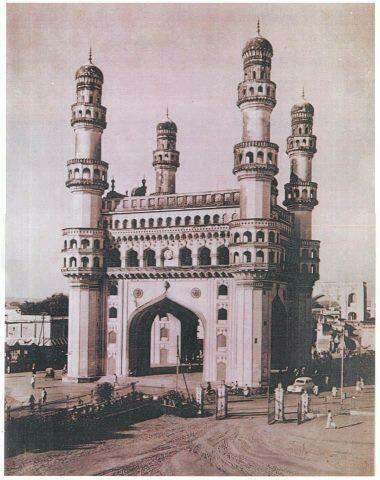
        The Charminar was the earliest aesthetic monument to be built in the newly planned city. According to some it is built like a taziya or a replica of the mausoleum of Imam Hussain. While some opine it is the city centre or piazza. Made of plaster and stone it stands majestically with four tall minarets with heights of 48.7 meters. The minarets have four storeys with 146 steps; while the main building has three floors and a mosque on the western side of the roof. The mosque has 45 prayer niches and open space in front.A school is also belived to have existed on the second floor of the monument. The Charminar is symbol of the city of Hyderabad and is one of India's marvels of architecture.


Charminar600.jpg                                     

Charminar, Hyderabad, built in 1591 by Sultan Mohammad Quli.

By Hoodedemperor - Own work, CC BY-SA 3.0, https://commons.wikimedia.org/w/index.php?curid=22763693

     The other structures include the Char Kaman or the four arches, located north to the Charminar about 75 metres away, originally called jilukhana (guard's square). At the centre of it was the char-su-ka-houz,
The western arch led to the palaces. Originally called Sher-e-Ali, it got changed to Sher-e-batil with time. The eastern arch is called Kali Kaman, the northern one Machli Kaman and the southern one Charminar Kaman; though initially they did not have any names. Musicians used to play shehnai (musical instrument)five times a day on the eatern arch. The western arch led to the palace area, where there was a serai (inn) and a hospital. 

    The palace area had an ornate and beautifully decorated gate. The doors were made of fragrant sandalwood studded with precious stones and nails of gold. A screen made of gold-cloth existed behind the doors.The palaces included the Lal Mahal, the Dad Mahal, The Jina Mahal, the Qutub Mandir and the Khudadad Mahal. Of these the Sultan stayed in the Qutub Mandir. The Dad Mahal was used for dispensing justice.Nadi Mahal with its pavillion, was at the bank of the river Musi which the Sultan used for relaxation. Servants attached to the palaces stayed at the Lal-mahal. The Khudadad Mahal had eight storeys and ws built after the marriage of Hayat Baksh Begum. Besides there was also Ala Mahal, the Koh-i-tur pavillion, the Sajan Mahal .The palaces don't exist anymore as they were destroyed during  the Mughal invasion of Hyderbad.
The area has the High Court building, City College etc.in present times, the 21st century.

     Mohammad Quli's poems have references to the palaces. Mohammad Quli built many gardens and pavillions like the Nabat Pahaad. Gardens were made in and around the city. Flowering and fruit trees abounded which made travellers mention them in their accounts.

     Mir Momin Astrabadi of Persia was the chief architect of the city. He was a poet too. He brought expert draftsmen and skilled craftsmen from Persia like Abu Talib,Kamal-ud-din Shirazi and Sheher Yar Jahan.

    The Badshahi ashurkhana is a religious building constructed in 1596 to house the alams (replicas)of the standards carried by the Prophet's grandson Hussain at Karbala. The whole place was lit up with Mohammad Quli lighting 1000 lamps everyday till the tenth day of the month of Moharram. The beautifully enamelled tiles at the Ashurkhana have inscriptions in Persian.

Badshahi Ashurkhana

Badshahi ashurkhana with tile work, built in 1596, Hyderabad.

By Madhu vottery - Own work, CC BY-SA 3.0, https://commons.wikimedia.org/w/index.php?curid=30298316

    Jama Masjid was built during the reign of Mohammad Quli, the second mosque in the newly founded city. I has a side entrance, and originally having a school teaching Arabic, a monastery and a bath attached.

File:Darulshifa, Hyderabad.jpg

Darulshifa area in Hyderabad.

By Hadisaab (Own work) [CC BY-SA 3.0 (http://creativecommons.org/licenses/by-sa/3.0)], via Wikimedia Commons

Darulshifa meaning house of cure was completed in 1595. It housed a medical college imparting Unani knowledge and a hospital. A salubrious environment was guaranteed to the patients; fresh air from the nearby river Musi. A Turkish style bath also existed but not any more.  
   
     Other than the palaces, inns, gardens etc. 14,000 houses were also built in the new city and allotted free of cost to traders and people from other professions. It took nearly a decade to complete the construction of the capital city, Bhagnagar( later Hyderabad) in order to shift from Golconda.

    Mohammad Quli's tomb was built during his lifetime. There is a double terrace and a colonnade runs around the mortuary chamber in the pillar and lintel style. The tomb itself is made of polished of black basalt on which Quranic verses are inscribed. The tomb mentions his birth-date,period of reign and date of death.


Tomb of Mohammad Quli at Hyderabad.
By Bernard Gagnon - Own work, CC BY-SA 3.0, https://commons.wikimedia.org/w/index.php?curid=34551238


Hyderabad city around the Charminar.

By Nagalakshmikavuri - Own work, CC BY-SA 3.0, https://commons.wikimedia.org/w/index.php?curid=28274186


The founder of Hyderabad passed away in 1612 and had said prophetically in a poem ''Oh God fill my city with people just as you have filled the river with fish''; Hyderabad has thence grown,still developing and ever changing.     


References :


  • Luther, Narendra/Prince,poet,lover,builder : Mohammad Quli Qutub Shah, the founder of Hyderabad,New Delhi : Publications Division, 1991.
  • wikipedia.org
  • http://shodhganga.inflibnet.ac.in


    Posted by :

    Soma Ghosh

    © author


    Wednesday, 16 November 2016

    Qutub Shahi dynasty ; bygone splendour


     Qutub Shahi dynasty : bygone splendour


        The Bahmani kingdom ruled the Deccan between 1347-1525 from Gulbarga initially and then from Bidar. However it disintegrated and five independent kingdoms evolved. The Qutub Shahis with capital at Golconda, the Imad Shahis with capital at Ellichpur, the Adil Shahis with capital at Bijapur, the Nizam Shahis with capital at Ahmednagar, The Barid Shahis with capital at Bidar.
      The founder of the Qutb Shahi kingdom was Sultan Quli, an immigrant whose paternal home was in Hamadan, Iran. The Bahamani empire had many afaqis or immigrants from Iran,Iraq,Turkistan, Arabia,Africa,etc. These afaqis gradually dominated society and occupied important posts. The society of Deccan was a cultural synthesis and included people of different ethnic origin,races,religion and culture etc. This lead to evolution of “Deccan culture” and later “Hyderabadi culture”which continues to this day.
        Sultan Quli came along with his uncle Allah Quli to Deccan and Bahmani ruler Sultan Mahmud Shah Bahmani received them well and appointed  Sultan Quli as one of his courtiers.He was given  horses, a jagir of Kurangal. He earned the title Qutb-ul-mulk beacause of his military and literary talent.He was appointed tarafdar(governor) of Telangana in 1495. and the fort at Golconda hill was added to his existing jagir. From this jagir evolved the Golconda fort-city and the capital which got densely populated with time.
             Sultan Quli rebuilt the mud fort which was originally built by the Kakatiyas and called Mankal. He renamed it as Muhammadnagar. In 1518, he declared independence and made Golconda his capital. He strengthened the defences of the hill and built strong ramparts. The fort-city included public buildings, mosques, offices, palaces, rest-rooms,gardens, baths etc.

    image004
    Fort view; pic by Isha Vatsa
    image010
    Fort view; pic by Isha Vatsa
    image008
    Fort view; pic by Isha Vatsa
    image006
    Fort views; pics by Isha Vatsa
    image033

    image012
    Cannon balls at fort; pic by Isha Vatsa
       Sultan Quli ruled for 50 years, 24 as governor and 26 as ruler before his assassination in 1542. The Golconda kingdom extended from Warangal to the Masulipatnam(now Machilipatnam) coast. His son Jamsheed Quli succeeded him who ruled for seven years.
       After him Sultan Ibrahim Qutb Shah,sixth son of Sultan Quli ruled after brief rule of few months of rule by Subhan Quli; for  30 years ie. 1550-80. Along with other Sultans of the Deccan subdued Vijayanagara, issued coins and patronised Telugu literature. He also had a great fondness for Persian and was responsible for the rise of Dakhni, precursor to Urdu.
       He built the bridge over the Musi river in 1578 in order to expand his capital. His son-in-law Hussain Shah Wali built the Hussain Sagar Lake. A new town Ibrahimpatnam was named after him.He was succeeded by his son, Muhammad Quli Qutub Shah who was only fifteen and the administration was handed over to Rai Rao and Mir Momin Astrabadi.
         Since Golconda was large, prosperous and densely populated, its fame of diamonds and printed cloth attracted traders from Europe and Asia, the need for a new city was submitted via a petition to the Sultan by the nobility. This was accepted and the plan for construction of a new city was prepared by Mir Momin Astrabadi. The Sultan laid the foundation in 1591 and named it Hyderabad, after the name of his beloved Bhagmati whose name was changed to Hyder Mahal after converting to Islam. Some opine that the city was named after Hyder, the title of the fourth caliph of Islam. Since the city had many gardens it has also been referred to as Baghnagar by historians and travellers. Hyderabad was built on the gridiron system in the form of a large double cross. The Charminar stands at the city centre, completed in 1592 and four roads extend from its portals. The city was divided into 12,000 muhallas(precincts). The city’s main roads were lined with shops, buildings, mosques etc. The Charminar is the most famous Qutb Shahi monument.The Sultan built many public buildings and beautiful gardens. The Charminar is flanked by four arches, the Charkaman at a distance of 375 feet from the centre. The gates are called Sher-e-ali kaman or Sher-e-batil , Kali kaman, Machli kaman, Charminar ki kaman.
    image015
    Charminar, Hyderabad
    By Ramnath Bhat from PUNE, India – Charminar, Hyderabad.(_MG_8622), CC BY 2.0, https://commons.wikimedia.org/w/index.php?curid=46768370
          The Qutub Shahis built many palaces like Khudadad mahal, Chandan Mahal,Sajan Mahal, Lal Mahal, Nadi Mahal and pavillions like Naubat Pahad and Koh-i-tur etc. Muhammad Quli Qutab Shah built the Badshahi Ashura Khana in 1595, where alams similar to the ones carried by Imam Hussain are kept. He also built commercial complexes around the Charminar including the Lad Bazaar. After Muhammad Quli Qutb Shah, his nephew Mohammad Qutub Shah, son of Mohammad Amin, succeeded him  in 1612 since he had no male heir. He ruled for 14 years. He laid out a few more gardens and continued work on the Mecca Masjid after getting sand from Mecca in Arabia. The mosque has huge dimensions with a prayer hall of 225 feet length and is 75 feet in height.Sultan Mohammad maintained a  fleet of ships and Golconda had good trade with Europe.He was succeeded by his eldest son Abdullah who supported trade with the British. The Golconda kingdom produced a variety of products and Masulipatnam was an important port city in its territory.
    image016
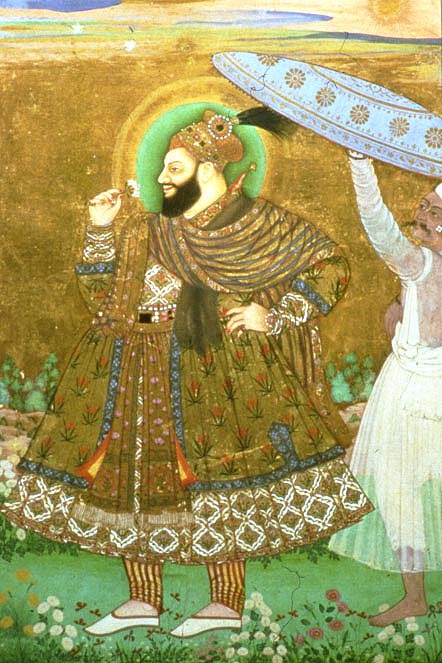
    Sultan Abdullah Qutub Shah
    By Unknown (production) – http://collections.vam.ac.uk/item/O73982/painting-sultan-abdullah-qutb-shah/, Public Domain, https://commons.wikimedia.org/w/index.php?curid=17712775
        Abdullah Qutub Shah had no male heir and his son-in-law Abul Hasan Tana Shah was made Sultan in 1672. Golconda fell to the Mughals after along seige in 1687 and along with the plunder of Hyderabad, the Mughals took away the accumulated wealth of Sultan Abul Hasan who spent his remaining life at Daulatabad.
    image018
    Sultan Abul Hasan Tana Shah
    By Minuchihr – http://www.brooklynmuseum.org/opencollection/objects/124863/Portrait_of_Abul_Hasan_the_Last_Sultan_of_Golconda/set/f6607578453e6ad0c407265b3ac89cfa?referring-=Portrait+of+Abu%27l+Hasan%2C+the+Last+Sultan+of+Golconda#http://www.brooklynmuseum.org/opencollection/labs/splitsecond/painting.php?id=132, Public Domain, https://commons.wikimedia.org/w/index.php?curid=17115478

    Golconda was famous for its diamonds and there were many mining sites within the kingdom. The Kohinoor, Hope Diamond, Pitt-regent, Idol’s eye,Dariya-e-noor, Noor-al-ayn are a few famous diamonds.
         The Qutub Shahi architecture was unique and included arches,pillars, arches, domes and minarets. The rulers originally came from Persia or Iran and were patrons of art and learning. They invited scholars, artists and craftsmen to their courts. Their architecture was originally a mix of Persian and Deccan styles. Later Turkish influences were seen. Their architectural structures include the fort,mosques,palaces, tombs and public utility buildings.  A very important building was the Darushifa which was  a general hospital and  attached to it was a college for Unani medicine. Qutub Shahis had their own coinage, patronised learning and the languages Persian and Dakhni. Many books were written in Persian in various subjects with their support. Sultan Muhammad Quli himself composed 15,000 couplets in Urdu.
       The fort stands on a hill, 400 feet above the plains around and is a large Deccani fort. Sultan Quli replaced the original mud fort and built a new stone structure with large gates. Many structures were built within and it became a fort with three fortifications. There were palace, gardens and mosques. The fort complex is in the shape of an irregular rhombus having a crenallated granite wall, a moat and a citadel called Bala Hissar. The Fateh Darwaza is the outermost gate. The other gates include Bala Hissar Darwaza, Banjari Darwaza, Jamali Darwaza, Naya Qila Darwaza and Moti Darwaza. Bahmani, Badhi, Mecca and Patancheru are the other gates. The fort has 87 bastions and 52 posterns. The Petla Burj, Musa Burj and Madina Burj are well known bastions. A cannon Fateh Rahbar is kept on Petla Burj. Structures inside the fort include Shamshir Kotha, Telka kotha,Dhan ka kotha,Jabbar Kotha, Jami Masjid, Ashur khana,Guard rooms, Hathirath mahal, Katora hauz,, Aslah khana,Ambar khana, Bahmani mosque. a Hindu temple, a throne for the Sultan ascended by ten steps. Palaces of Tarmati and Pemamati , ladies from the royal harem, were also built.
        Mushk Mahal was a palace built in 1673 by Miyan Mishk. Toli Masjid was built by Musa Khan, a mahaldarof Abdullah Qutub Shah in 1671. Mosques at Saidabad and Mirpet, which has calligraphy by Hussain b.Mahmud Shirazi were  built by Mohd Quli Qutb Shah. Mosques exist at Khairatabad, Musheerabad and near Puranapul at Hyderabad from the time of the Qutub Shahis.
       To the north west of the fort are situated the Qutub Shahi tombs in a garden ambience built in their typical architectural style.
    image025
    Qutub Shahi tombs, view from the fort.
    By Unknown – http://www.bl.uk/onlinegallery/onlineex/apac/photocoll/g/019pho0000752s5u00021000.html, Public Domain, https://commons.wikimedia.org/w/index.php?curid=8039174
         Deccani qalam is the style of painting which evolved under the Qutub Shahis. The kalamkari techniques of Pallakolu. Masulipatnam, Kalahasti flourished in their reign. Picchwais were also produced during the Qutub Shahi rule, expressing themes from Lord Krishna’s life.
    image028
    Miniature painting during Qutub Shahi rule
    By (Deccan, Golconda), – http://www.brooklynmuseum.org/opencollection/labs/splitsecond/painting.php?id=122, Public Domain, https://commons.wikimedia.org/w/index.php?curid=17115143
    image021
    Ragamala painting, Golconda school
    By Deccan School – http://www.harekrsna.com/sun/features/12-11/features2319.htm, Public Domain, https://commons.wikimedia.org/w/index.php?curid=21077970
    References :
    H.K. Sherwani/History of the Qutb Shahi dynasty, New Delhi ; Munshilal Manoharlal,1974
    H.K. Sherwani/Muhammad Quli Qutb Shah founder of Haidarabad, New Delhi : Asia Publishing House,1967.
    M.A.Nayeem/The heritage of the Qutb Shahis of Golconda and Hyderabad,Hyderabad: Hyderabad Publishers,2006
    M.A.Nayeem/The splendour of Hyderabad, Hyderabad Publishers: Hyderabad,2002.

    Posted by :

    Soma Ghosh

    © author